Monday, 9 April 2012

Saying 'no' in Japanese

When I first when to Japan - and to be honest, even now, a little bit - one of the unexpected difficulties for me was learning how to say 'no'.

I don't mean that in a figurative sense. I mean literally, I didn't know how to say 'no'.

In English, 'no' is used in a lot of different situations.
'No, thank you.'
'No, that's not correct.'
'No! Stop that!'

If you study Japanese, you will very quickly learn the word いいえ ('iie'), 'no' (or a more casual 'uun', a sound you will soon pick up if you go to Japan!). However, if you reply with 'iie' in every situation where you'd use 'no' in English, you will sound strange and sometimes even rude.

For example, if someone asks you if you want more food, or if you want a carry bag, you don't say 'iie, arigatou' for 'no thanks'. That is a literal translation from English, but it would sound weird. Rather, you could say 'kekkou desu', which is more like 'I'm fine'. Less politely, 'iranai', which means 'not necessary' (I don't need it).

For situations where something is not good or not okay, you can use 'dame'. This is also what you hear parents say to their children. 'Dame!' 'No!'

If you want to express frustration with 'no!!' or 'oh no!', exclamations like 'iya da!' or 'yabai' would be more suitable.

If you want to say something is not correct, you can say 'chigaimasu' (it's wrong/different). Or you can mirror back the verb the first person asked you. For example, 'dekiru?' ('can you do it?'), 'dekinai!' ('no, I can't!'). These are often, but not always, preceded by an 'iie' or 'uun'.

If you are refusing a request or saying something that might be awkward for the other person, it's also common to avoid an outright 'no'. 'Sore wa chotto...' ('that's a bit...') or 'muzukashii desu ne...' ('that's a tough one...') or various other vague statements or excuses. This is a famous aspect of Japanese culture, the unwillingness to bluntly say 'no'.

If someone thanks you and you want to say 'no, no, it's nothing', you can say 'iie, iie'. You can also use 'iie' to deny praise ('iie, tondemonai' 'oh no, not at all').

And in some cases, you can even say 'hai' ('yes') where we would say 'no' in English. Japanese and English negative questions function differently. For example, in English, you answer negative questions like this:
'Don't you like it?'
'No, I don't like it...'
But in Japanese, you match the tense of the question in your answer.
'Don't you like it?'
'Yes, I don't like it...'
It's difficult, isn't it! I've used a mixture of polite and casual Japanese on this page. As you can see from this list, although 'iie' is often used, it is often followed by another word, and in many cases, is not used where we would use the English 'no'. So it can take a little while to pick up when to use which answer in the real world. ^_^

Saturday, 10 December 2011

JLPT N3

I recently took the JLPT (Japanese Language Proficiency Test) here in Australia. Heh, it was quite a contrast to taking the JLPT in Japan. Here in my state, there were only four other people taking my level; in Japan, there was a huge room full of people and a very 'university exam' sort of feeling.

You are strictly forbidden to share the content of a JLPT test online, so I won't be doing that. But here's a brief overview of how the test was structured:

Section 1: vocab and kanji. We had 30 minutes for this, and there were five sections. For example, one section had a sentence with underlined kanji words, and you had to choose the hiragana reading for that kanji. Another section had a vocabulary word, and you had to choose the sentence that used that word correctly in context.

Section 2: grammar and reading, lasting 70 minutes. The grammar section includes grammar questions, some 'put the words in the correct order' questions, and a 'choose the correct grammar to fill in the blanks in this story' questions. There are several short and medium-length readings with comprehension questions. This tends to be the section that people find difficult; you can't be too slow at reading, and you need to know a reasonable amount of kanji, vocab and grammar to do well.

Section 3: listening, which takes about 40 minutes. There are several listening sections; some have you choose pictures that correspond to the correct answer; some have you choose sentences; others have nothing written on the page but you must listen and then choose the right answer by listening. Listenings are played only once each.

We had a short break between each section.

All in all, the experience and test style were similar to the old JLPT level 3 that I took several years ago. The main difference from the old tests - and the one they advertise - is that they are trying to test practical/communicative skill a bit more. Obviously, this is difficult to do in a multiple-choice paper test, but some of the ways they did this were:

  • a grammar section where you must organise words into the correct order in a sentence
  • listening questions where you must choose what language a person would actually use in a given situation (for example, if you're greeting a customer, or offering to help someone, what expression would you use?)
  • having a 'real world' reading text (where you must find relevant information in a brochure or timetable, etc)

I think these are nice additions. This sort of thing comes more naturally to you if you have lived in Japan and learned most of your Japanese in real world situations anyway.

So how did I do? I think I did pretty well. My weakest section was probably grammar/reading. I had enough time to read (reading is the area I practised most, pre-test). But I didn't have time to re-read, and I tend to miss questions if I can't re-read a text carefully. The problem I have with reading is that I tend to dither between two answers that seem like they could both be correct; I've obviously overlooked a nuance or misunderstood a particular word, so I can't confidently pinpoint the correct answer.

In this recent post I mentioned the study materials I'd been using. How well did they prepare me for the actual test? They were okay; I think they set a slightly higher standard than the real test required. The 'sample test' book was useful as it helped me work out what grammar points I needed to study. Then I referred to the grammar book ('Sou Matome') to check the meaning/use of those points.

The reading book ('Jitsuryoku Up!') was useful, and the most interesting to study with. I mentioned that this reading book had quite difficult readings, as none of the kanji had furigana, and they used some quite difficult words. The real test did have more furigana than that book; you still needed to be able to read quite a few kanji, but you weren't expected to know all of them. So in regard to kanji, the real test was easier than in Jitsuryoku Up. The complexity of the texts was similar, though.

It also seemed like the real test's kanji/vocab section was easier than any sample test I had taken. Actually, this happened to me last time I took the JLPT. Each time, I did several sample tests, and didn't do very well on the kanji/vocab - always lots of answers I was completely guessing. On the real test, it seemed like they were not testing at quite such a high level and the words were more familiar. Perhaps I just got lucky both times. Anyway, I think it's always better to do sample tests that are more difficult than the real thing; that way, the real test won't come as a shock.

Tuesday, 13 September 2011

Useful Japanese phrases (that are difficult to translate)

There are some useful, commonly-heard Japanese words and phrases for which there is no perfect English equivalent. When I was in Japan, and talking to Japanese people in English, I used a lot of these words because they were culturally appropriate, or because they expressed my meaning more accurately than English could. (Or just because they're fun to say. ^_^)

itadakimasu! This is something Japanese people say right before eating a meal. In subtitles, it's often translated as 'bon appetit!' I don't know if it can really be translated. Maybe a combination of 'thanks for the food', 'I'm going to start eating now', etc.
Have you heard of 'keigo'? 'Keigo' is especially polite Japanese. When speaking very politely - for example, to a customer - Japanese speak differently and even use some different verbs. 'itadakimasu' is a polite, humble way of saying receive, accept, take, eat, drink, etc. So it's literally saying 'I (humbly) accept this food'. Although it sounds very polite, it's common, everyday Japanese and you can use it when eating out casually with friends too.

gochisousama (or more politely, gochisousama deshita) Just as you say 'itadakimasu' when starting a meal, you can say 'gochisousama deshita' after finishing. It literally means 'it was a feast!' but you can use it to mean a combination of 'that was great', 'thanks for the meal', 'I'm finished', etc.

irasshaimase! is the common greeting in shops. It means 'welcome'. You will hear this all the time from shop and restaurant staff. You don't have to reply to it. The verb 'irasshaimasu' is another keigo (very polite) verb meaning 'come, go, be'. So I guess it means 'come in' or something, in a very polite way.

osaki ni (or more politely, osaki ni shitsurei shimasu) You can say this if you do something before someone else. For example, if you are the first person to start eating something, or if you leave before someone else, you can say this as a way of excusing your bad behaviour. ^_^ 'Osaki ni' literally means 'before', and 'shitsurei shimasu' is like 'I'm rude' or 'please excuse me'.

ojama shimasu! 'Ojama' means something like 'intrusion' or 'nuisance'. You can say this when you enter somebody else's house. Even if they're your friend and they invited you, you can say this as you walk in, like 'oh, sorry to intrude'. Basically doesn't mean much beyond 'I'm coming in now!'

otsukaresama (or more politely, otsukaresama desu or otsukaresama deshita) Co-workers often say this to each other. It can be said at the end of a working day, or after a big effort/project at something, or just as a general sort of greeting throughout the day. It means something like 'we're/you're working hard', 'you must be tired', 'you've worked hard', 'we're working hard', 'keep up the good work'. It's a nice, and simple way, to acknowledge someone else's work and effort. 'tsukare' means 'tired', and the 'o' and 'sama' make it more polite. This is a polite way to acknowledge someone else's tiredness. I learned this expression quickly, as in the department store where I worked, any time any staff member met another in the corridor or elevator, they'd greet each other with 'otsukaresama desu!'

shou ga nai (or shikata ga nai) This expression means something like 'it can't be helped', 'we can't do anything about it' or 'oh well'. It indicates a sort of resignation and acceptance of a situation. Some people say this is a fairly typical attitude of Japanese in the workplace; a lot of people shoulder overtime or unfair work pressure with a 'shou ga nai' attitude, instead of complaining or fighting for their rights. A fair assessment? I don't know, but some companies do seem to assume their employees will take such an attitude.

genki This word can be translated to mean 'cheerful', 'happy', 'healthy', 'energetic', etc. If you ask someone 'genki desu ka?', you're asking if they're well. But because 'genki' encapsulates several different ideas, there's no perfect English equivalent. You can use it to describe someone who is perky and bubbly, or a child who is running around screaming, or a person who is healthy, or students who are actively participating in something...

mendokusai This is often translated by dictionaries as 'troublesome'. I usually translate it as 'it's a pain'. If something is a 'mendokusai', it's annoying or tedious to do, a pain, a disagreeable duty.

mottainai This means something like 'wasteful', but seems to be used to mean 'waste not, want not'.

sasuga This means 'what you'd expect'. For example, if your friend, who is very smart, gets the highest score in the class, you could say 'sasuga!' ('that's typical of you' or 'that'd be right') to show you are not surprised!

toriaezu This means 'at first' or 'to begin with'. It's often used in ordering, as in 'toriaezu, nama bi-ru' (for now, draft beer).

yoroshiku onegaishimasu A big one! This is a kind of greeting that people use a lot, especially at the beginning of a new relationship. For example, if you're a new employee, you will say this to people you meet, and they'll say it back to you. If you're a new student at a school, if you have to stand up in front of the class and introduce yourself, you'll say this. If you start a project and you need to ask people to work with you on it, you'll say this.

We really have no English equivalent; in these situations we'd just say 'nice to meet you', 'I look forward to working with you', 'I look forward to meeting all of you', 'I hope for your cooperation', etc. 'Yoroshiku' literally means 'well' or 'properly', and 'onegaishimasu' means 'please'.  It really means something like 'please treat me well' or 'let's work happily together' or 'let's have a good relationship'.

You can say it more casually as simply 'yoroshiku', and this can also mean something like 'best regards'.

Wednesday, 31 August 2011

Random Pictures (8)


If it is not immediately obvious, this is a piece of very freshly made senbei (rice cracker) with octopus in it. ('Oh, of course!') When I say it's 'freshly made', what I mean is that at this stall, the staff actually put the senbei mixture down, put a fat, juicy, fresh octopus tentacle on there, and then apply the equivalent of a vice to crush it into paper thinness! If you want to try this (it was pretty good!), they are specialties of Enoshima island.


I'm not sure if this thing is supposed to be cute or supposed to be nightmare fuel for young children. Either way, I'm about as close to it as I wanna be.


Sorry for the poor image quality on this one. Here are Street Fighter 'combination' meals. Get it? Combination? Ha ha ha. Sadly I had already eaten when I came upon this restaurant, so I will probably never get to eat the same beef fried rice that Cammy likes. ^_^

Saturday, 20 August 2011

Random Pictures (7)


Well... you can't say they didn't give you a choice.


I first mentioned this diner, Bubby's, way back in my first month of blogging (see entry).  I finally got a picture of the sign!  As I mentioned, this is a pie cafe, and has a very homey, American-style 'mom's home cooking' kind of vibe. And as we all know, all American family restaurants include just a little bit of profanity.


Yeah, buy them a nice chew toy instead.

Thursday, 18 August 2011

Random English

Japanese music often uses random English words. You'll be listening to a verse and chorus in only Japanese, and suddenly the singer will bust out 'only you forever', or 'I'm just a woman', in English. I suppose these words serve a decorative purpose...?

Sometimes, a Japanese artist will sing half their song - or a whole song - in English. How well this works depends considerably on the skills of the artist.

Monkey Magic, Orange Range

Listen to the song and try to imagine what they're saying...

The first time I heard their version of this song, I didn't even realise they were singing English. Sure, it didn't sound quite Japanese, but the pron was SO bad I wasn't sure. This is what I heard:

Punkama ei gadda mountain da
A punky is monkey got at the top
He knew every magic bisu unto the sun
This gaja everyone could hack some for

(Actual lyrics:
Born from an egg on a mountain top
The punkiest monkey that ever popped
He knew every magic trick under the sun
To tease the gods and everyone and have some fun)

Treat or Goblins, Megumi Hayashibara

Listen to the song.

'Monkey Magic' is my pick for 'most poorly pronounced English in a song' I've heard, but 'Treat or Goblins', which is an anime theme song, gets my pick for 'weirdest and most nonsensical English in a song'.

When she sang the English parts, I could tell there was something strange about them - they didn't sound like Japanese - but I had no idea what she was saying or what language it was. After I looked up the lyrics, I wasn't surprised.

Patch, patch with something red, like a maraschino cherry, and frozen
cranberry.
Chut, chut with someone hot, like an equilitarian, and Yam-yngdourian.
Fad, fad with something cool, like a hidden luminary, and will-o-the-wisp, too.

Yeah.

Sunday, 14 August 2011

A week of eating

Since I like food so much, I thought I'd show you my week of good food in Tokyo and Kanagawa. ^_^ Prices are approximate since I don't really remember.

From Tonkatsu Wako (a chain)

This is tonkatsu - deep-fried, breaded pork. This set, which cost about ¥1200, came with ro-su tonkatsu (pork loin), two ebi fry (shrimp), rice, shredded cabbage, miso soup and pickles. This particular picture was taken in Kawasaki's underground mall, Azalea.

When you eat here, there are staff on hand to refill your cabbage (although it's quite a mound to begin with). I don't know why but I find that funny.

From Khazana, on B1F of Queen's Square in Minato Mirai, Yokohama

Mmm! There is a lot of good Indian food in Japan, mostly in small shops run by Indian staff. This particular place has a lunch buffet for about ¥1200 (1400?) yen per person. A good deal, because it's delicious. ^_^

From an Italian restaurant in La Citadella, Kawasaki

Italian food in Japan is a mixed bag. In general, foreign food in Japan is quite good - Indian, Thai and Chinese, for example - but there are loads of 'cafes' with really dismal, insipid pastas (not to mention pastas with really strange ingredient choices). If you find a real Italian restaurant that is trying to serve proper Italian food, however, the food is often quite good. Pizza, in Japan, is often really nice - simple, with fewer toppings (so long as you avoid the Domino's-style monstrosities where they top pizzas with entire hot dogs, wheels of Camembert cheese or foie gras -_-).

La Citadella in Kawasaki is an 'Italian town' with several good Italian restaurants. In this picture, the pizza and pasta were about ¥1000 each.

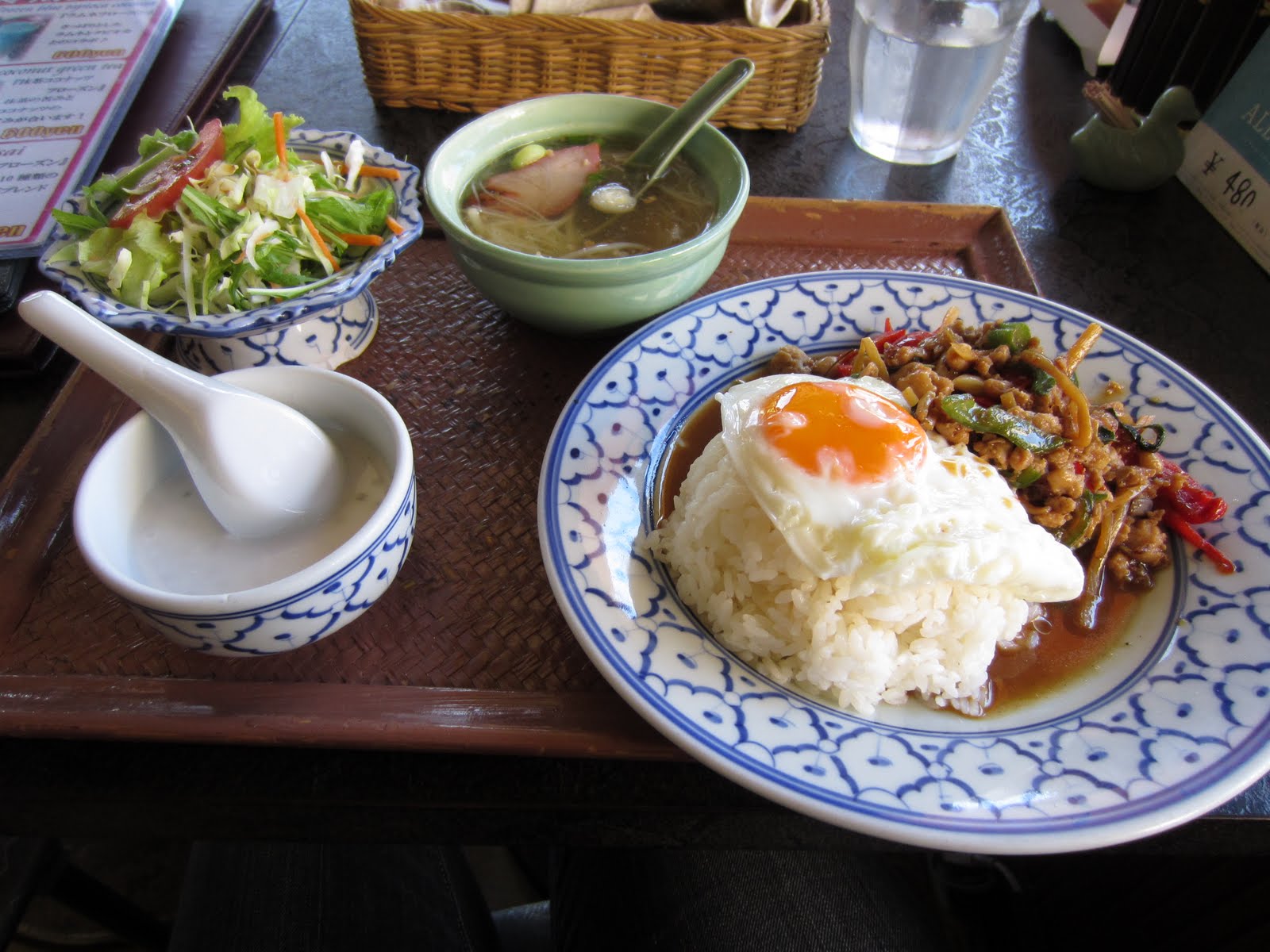
From Sawasdee, outside Daiei mall in Yokosuka

This Thai set meal was only about ¥800 and included the main (gapao), salad, noodle soup, dessert and a drink. I'd certainly recommend this restaurant if you're in the area.

From a restaurant near Fujisawa station

This is part of a Chinese meal I shared with a friend. You can get these sorts of dishes anywhere; there are masses of Chinese restaurants in Kanagawa. Each dish was about ¥800-1000. That pork and 'piman' (small peppers) dish is one of my favourite dishes to order.

From a soba restaurant in Atre, Ebisu

Finally, some more Japanese food. This is 'zarusoba', served cold and topped with nori (seaweed). Soba is a good accompaniment for tempura, since it tastes so wholesome, while tempura is more greasy. This particular tempura dish includes a prawn, okra, eggplant and fish. You take the soba and dip it in sauce before eating it. This is a very standard sort of dish; I got it for perhaps ¥1000. Note that cold soba is a very typical summer dish, so that in winter, there may be fewer of them on the menu.

From a department store around Yokohama station

Speaking of soba, here's soba in a different form - hot, in broth. This was a 'mini oyakodon set' which cost about ¥900. Oyakodon is a donburi (rice bowl dish) with an egg/chicken mix on rice. The 'oyako' in 'oyakodon' literally means 'parent child'. I know, it's a disgusting name!

Oyakodon's flavour is really nice and the juice flavours the rice underneath, but oyakodon often has the problem of using really fatty chicken pieces. This particular oyakodon was quite hard to eat. -_- Also, despite the title 'mini oyakodon' - where both the oyakodon and soba are in serving sizes smaller than normal - this was a huge meal!


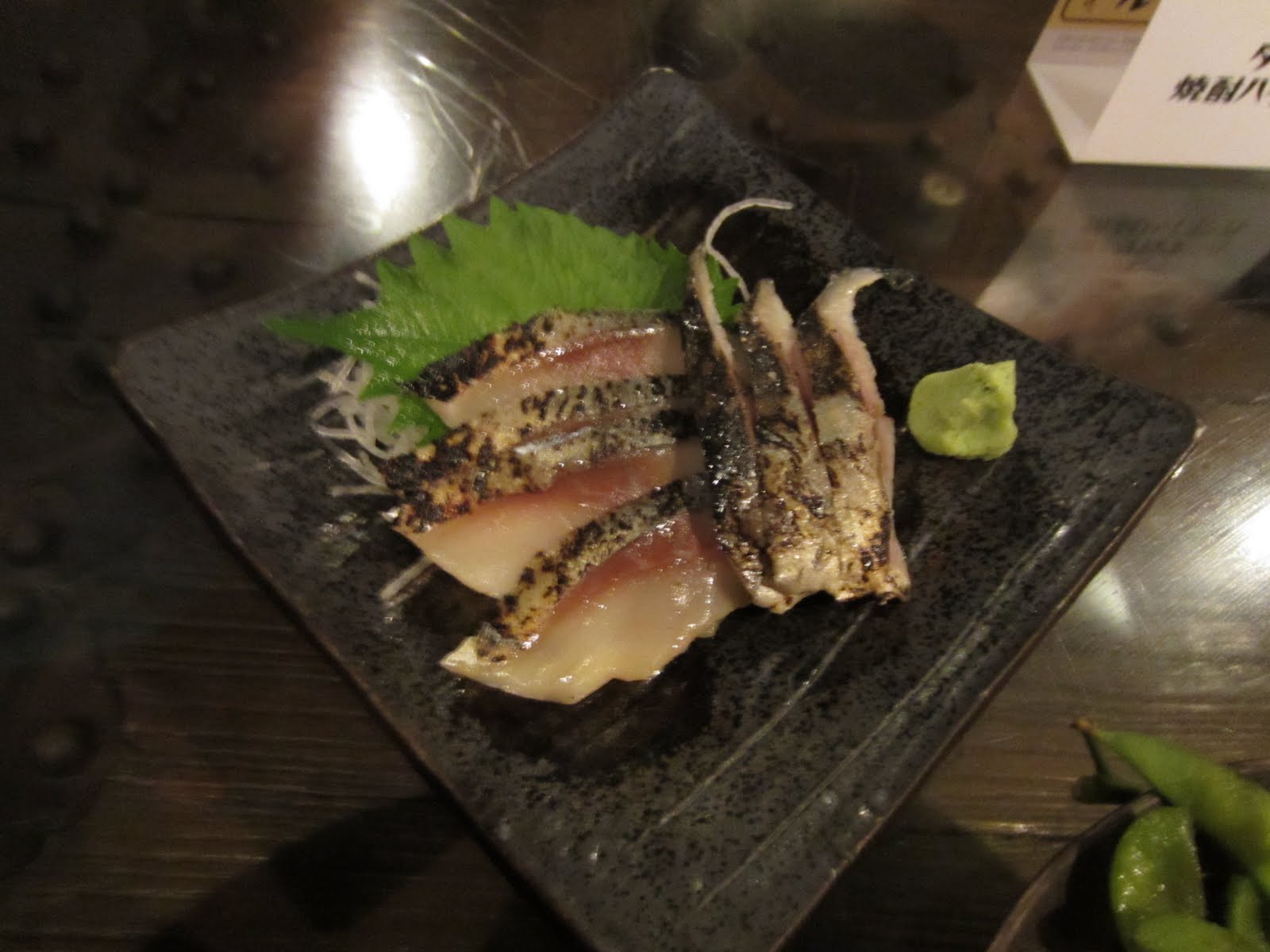
These last three are examples of izakaya food. Izakayas, you may recall, are Japanese-style restaurants where you order lots of little dishes to share, and booze flows freely. A typical dish is ¥400-600 yen. I couldn't post all the dishes we had, but the first one is mackerel sashimi, the second edamame (soy beans) and the third is deep-fried tofu.