
I haven't updated this blog in a long while - having been back in Australia for quite some time now - but I'm just checking in to mention my new blog.
It's called ESL Ideas and has lesson ideas, resources, tips, etc, for teaching English as a second language. I'm also moving some of my posts from this blog (suggestions for beginner teachers) to that one, and expanding on them a little.
Cheers.
Wednesday, 28 August 2013

Wednesday, 22 May 2013
JLPT N2 study materials (part 2)
It's rather a long time since I wrote JLPT N2 study materials (part 1) (see also N3 study materials), but since then I have accumulated even more textbooks; I should be able to open my own Japanese language library any day now... As expected, I didn't pass the test last year - only the listening section - but I am still slowly plugging away at the Japanese and hopefully this year will do better.
Without further ado, here are some more JLPT N2 materials I've been using.
新完全マスター聴解
This book - one in a series focusing on different skills, for various JLPT levels - focuses on listening skills. It comes with two CDs full of listening exercises. The accompanying textbook includes sample JLPT-style questions, explanations of different listening problems with practice exercises, and transcriptions of all the audio.
The listening here is not purely listening to full JLPT-style audio conversations, although there's plenty of that. There are shorter exercises focusing on typical listening problem areas, such as spoken contractions (-te iru = -teru, -te shimau = -chau) and pronunciation, identifying whether a speaker is, say, asking permission to do something or asking the listener to do something, agreeing or disagreeing, etc.
All explanations in the textbook are purely in Japanese (with furigana etc). They shouldn't be too difficult to follow, unless you really are just moving on from N3 and didn't pass N3 very strongly. In any case, good reading/vocab practice. Overall, it's a good book, I feel.
日本語パワードリル(N2文法)
As the title suggests, this book consists of lots of grammar practice questions. There are a few pages practising specific types of grammar (sentence endings, particles like 'ni', 'o', etc') but mostly the book consists of 30 10-minute sections, each with a variety of question: 10 general grammar questions, 4 'put the words in order' questions and 3 'read this passage and choose the right language to fill in the blanks' questions (all question types that appear on the actual JLPT).
There are no grammar explanations in this book, so this would work well in conjunction with another resource, eg, the Internet or a grammar textbook, so that you can look up the ones you didn't know or understand.
This book is useful for grammar drills, but it would be more useful when you have a good bit of vocab/kanji behind you. The reason is none of the words in this book have furigana, and there may be sentences you can't understand if you can't read all the words in the sentence. As someone with rather weak vocab, I find I often don't know which answer is correct because I haven't understood one or two crucial vocabulary words in the sentence, rather than the grammar. I suppose this is good practice for the real test. In any case, even if your vocab is weak, there are loads of grammar questions in this book, so you should be able to find lots of questions that you can read!
Shadowing 日本語を話そう 中~上級編
This is not a JLPT-specific resource, but it's designed for intermediate-level students wanting to improve listening, reading, speaking, etc through the technique of shadowing. Basically, this involves listening to short but full-speed Japanese conversations (and you can read along in the book). You listen a couple of times, then try, eg, repeating after the speaker, or reading them at the same time. It has different types of listening (casual conversations between friends, polite conversations in public settings, etc) and has a mixture of 'intermediate' and 'advanced' level listenings. I like that all the conversations have Japanese transcriptions and English translations.
Personally, I find shadowing a bit boring but I suppose that's the point of having each track so short - each page/track is just one or two minutes long, with several conversations on each page - so you can do short bursts of it. It's a good resource, but I haven't used it much, because I did find it somewhat repetitive.
日本語能力検定試験N2[読解・言語知識]対策問題&要点整理
Catchy title, huh? This is another book in a series designed for JLPT practice. As with a lot of practice test material, it's better to start using it after you've been levelling up for a while. I mean, because the reading texts approximate what you'd find on the actual JLPT N2, you probably won't be able to understand much of them if you're fresh out of N3. As with the test, it's broken into different types of reading - shorter texts, longer texts, comparing two texts and finding information in 'real world' texts, and a practice test at the end. There are lengthy explanations of the correct answers, etc. (Frankly, I don't find the explanations of the answers any easier to understand than the actual readings. If you didn't understand the reading properly, you'll probably be all the more confused after struggling through the explanations.)
実力アップ!日本語能力試験N2読む(文章の文法・読解)
This is another N2 reading practice book; again, it has a lot of texts with sections similar to those on the real test. As with the previous reading resource, this book is good once you're starting to near N2 level and can benefit from reading texts that are similar to N2 level. A nice feature of this book is a 'quick reading' section with furigana over kanji, but most of the book doesn't have this support (and so is more like the real test). As I said in my review of N3 materials, I had the N3 version of this book and liked it.
I like this reading resource better than the 対策問題 reading book I just described (although the other one has the benefit of a practice test in the back). I think this one makes a little more of an effort to teach you something, rather than just presenting lots of practice; along with the texts there are useful expressions and vocabulary lists - with English translations, even. Another plus is that it includes grammar reading tasks, like on the test, where you read a short passage and must fill in the blanks with the appropriate grammatical expression.
中級を学ぼう―日本語の文型と表現82 中級中期
All these JLPT-specific skill books I've written about are useful for working toward JLPT, and many of them are really good, but they are pretty boring if they are your only resource. Also, some, like the reading practice texts, are not so useful for the gradual process of getting yourself from N3 level to N2 level - they're better when you're close to N2 level already and want to practise more. Therefore, it's quite nice to have an actual general-use textbook like this one, which covers a variety of skills.
I finished my previous textbook (テーマ別中級から学ぶ日本語, which, for simplicity's sake, I'll just refer to from here as 'Japanese by Topic') and I've gone onto this one. I had started to get bored with 'Japanese by Topic' (despite praising it highly in my previous JLPT post) by the end; because of that, this new one seems great by comparison. Like 'Japanese by Topic', this is a general study book - not specifically targeted at JLPT students but containing a mixture of vocabulary, grammar, reading and listening.
Comparing the two:
Without further ado, here are some more JLPT N2 materials I've been using.
新完全マスター聴解
This book - one in a series focusing on different skills, for various JLPT levels - focuses on listening skills. It comes with two CDs full of listening exercises. The accompanying textbook includes sample JLPT-style questions, explanations of different listening problems with practice exercises, and transcriptions of all the audio.
The listening here is not purely listening to full JLPT-style audio conversations, although there's plenty of that. There are shorter exercises focusing on typical listening problem areas, such as spoken contractions (-te iru = -teru, -te shimau = -chau) and pronunciation, identifying whether a speaker is, say, asking permission to do something or asking the listener to do something, agreeing or disagreeing, etc.
All explanations in the textbook are purely in Japanese (with furigana etc). They shouldn't be too difficult to follow, unless you really are just moving on from N3 and didn't pass N3 very strongly. In any case, good reading/vocab practice. Overall, it's a good book, I feel.
日本語パワードリル(N2文法)
As the title suggests, this book consists of lots of grammar practice questions. There are a few pages practising specific types of grammar (sentence endings, particles like 'ni', 'o', etc') but mostly the book consists of 30 10-minute sections, each with a variety of question: 10 general grammar questions, 4 'put the words in order' questions and 3 'read this passage and choose the right language to fill in the blanks' questions (all question types that appear on the actual JLPT).
There are no grammar explanations in this book, so this would work well in conjunction with another resource, eg, the Internet or a grammar textbook, so that you can look up the ones you didn't know or understand.
This book is useful for grammar drills, but it would be more useful when you have a good bit of vocab/kanji behind you. The reason is none of the words in this book have furigana, and there may be sentences you can't understand if you can't read all the words in the sentence. As someone with rather weak vocab, I find I often don't know which answer is correct because I haven't understood one or two crucial vocabulary words in the sentence, rather than the grammar. I suppose this is good practice for the real test. In any case, even if your vocab is weak, there are loads of grammar questions in this book, so you should be able to find lots of questions that you can read!
Shadowing 日本語を話そう 中~上級編
This is not a JLPT-specific resource, but it's designed for intermediate-level students wanting to improve listening, reading, speaking, etc through the technique of shadowing. Basically, this involves listening to short but full-speed Japanese conversations (and you can read along in the book). You listen a couple of times, then try, eg, repeating after the speaker, or reading them at the same time. It has different types of listening (casual conversations between friends, polite conversations in public settings, etc) and has a mixture of 'intermediate' and 'advanced' level listenings. I like that all the conversations have Japanese transcriptions and English translations.
Personally, I find shadowing a bit boring but I suppose that's the point of having each track so short - each page/track is just one or two minutes long, with several conversations on each page - so you can do short bursts of it. It's a good resource, but I haven't used it much, because I did find it somewhat repetitive.
日本語能力検定試験N2[読解・言語知識]対策問題&要点整理
Catchy title, huh? This is another book in a series designed for JLPT practice. As with a lot of practice test material, it's better to start using it after you've been levelling up for a while. I mean, because the reading texts approximate what you'd find on the actual JLPT N2, you probably won't be able to understand much of them if you're fresh out of N3. As with the test, it's broken into different types of reading - shorter texts, longer texts, comparing two texts and finding information in 'real world' texts, and a practice test at the end. There are lengthy explanations of the correct answers, etc. (Frankly, I don't find the explanations of the answers any easier to understand than the actual readings. If you didn't understand the reading properly, you'll probably be all the more confused after struggling through the explanations.)
実力アップ!日本語能力試験N2読む(文章の文法・読解)
This is another N2 reading practice book; again, it has a lot of texts with sections similar to those on the real test. As with the previous reading resource, this book is good once you're starting to near N2 level and can benefit from reading texts that are similar to N2 level. A nice feature of this book is a 'quick reading' section with furigana over kanji, but most of the book doesn't have this support (and so is more like the real test). As I said in my review of N3 materials, I had the N3 version of this book and liked it.
I like this reading resource better than the 対策問題 reading book I just described (although the other one has the benefit of a practice test in the back). I think this one makes a little more of an effort to teach you something, rather than just presenting lots of practice; along with the texts there are useful expressions and vocabulary lists - with English translations, even. Another plus is that it includes grammar reading tasks, like on the test, where you read a short passage and must fill in the blanks with the appropriate grammatical expression.
中級を学ぼう―日本語の文型と表現82 中級中期
All these JLPT-specific skill books I've written about are useful for working toward JLPT, and many of them are really good, but they are pretty boring if they are your only resource. Also, some, like the reading practice texts, are not so useful for the gradual process of getting yourself from N3 level to N2 level - they're better when you're close to N2 level already and want to practise more. Therefore, it's quite nice to have an actual general-use textbook like this one, which covers a variety of skills.
I finished my previous textbook (テーマ別中級から学ぶ日本語, which, for simplicity's sake, I'll just refer to from here as 'Japanese by Topic') and I've gone onto this one. I had started to get bored with 'Japanese by Topic' (despite praising it highly in my previous JLPT post) by the end; because of that, this new one seems great by comparison. Like 'Japanese by Topic', this is a general study book - not specifically targeted at JLPT students but containing a mixture of vocabulary, grammar, reading and listening.
Comparing the two:
- this book comes with CD included, so it's better value for money
- this book has furigana with kanji - so you can work through it more easily without a teacher helping you - but the furigana are written in red, and there is a red sheet provided with the book. This means that if you want to try to read pages without furigana help, and test your kanji reading skills, you can easily slip the red sheet over a page and immediately hide all the furigana
- this book has new vocabulary threaded through the readings and grammar sentences, but doesn't present you with huge, daunting lists as in the other book
- my impression is that this book starts from a higher level than 'Japanese by Topic', but finishes at a slightly lower level than that book does ('Japanese by Topic' takes a huge leap in difficulty through the book)
- this book has more focus on grammar - more practice questions, example sentences, etc
- this book includes a variety of reading passages, some longer, some mere paragraphs long, which can make a nice change of pace
(Update: I've just written a post on my other blog specifically about the different N2 grammar textbooks I've used - most of them not reviewed on this page.)
Saturday, 8 December 2012
Persistence
Haha... found this entry in my Yokohama diary:
Had a ridiculous 10-minute exchange with some Japanese guy at my door tonight.
It seems like when people come to the door here, they don't just give a decorous knock, wait a few moments, then ring, then wait again. No, it's pound-pound-pound and immediately ringing the bell twice, then pounding again, all before you've even had time to stand up. It gives you a real feeling of urgency, like there must be some kind of emergency happening, and you'd better get to the door QUICK!
So anyway, I got there and the first thing he asked me was how long I'd been living here. My immediate thought was 'oh no, perhaps he's one of my neighbors and he's going to complain about hearing noise from my apartment'. But I told him, and his next question was where I was from. I said Australia, and he said: "oh! Ian Thorpe!' I looked at him blankly (because I still had no idea who he was or why he was at my door) so he mimed some swimming strokes. He then said I was beautiful - bijin, kawaii. I became suspicious.
The ensuing conversation consisted of him firing off very long sentences, followed by my blankly repeating the last 3-4 words of that sentence.
Him: blah blah blah blah blah blah blah blah blah blah blah blah blah blah blah blah blah dekiru desu ka?
Me: ...dekiru desu ka... uh...
And when I did correctly understand him, I didn't know what he was on about.
Him: Can you read Japanese?
Me: I can't read kanji.
Him: When do you you think you'll be able to read?
Me: ?? (thinking I must have misunderstood the question)
Him: When will you be able to read? June? July?
Yeah, I should be able to master 2000 or so kanji in the next couple of weeks, no worries. Shouldn't take longer than that to master the entire Japanese written language, no worries.
Finally asked him 'um, sorry, but who are you?' Finally discovered that he was selling newspaper subscriptions. I find it very difficult to believe that he could persist in a 10-minute one-sided conversation with someone who understood not a lick of his Japanese, and imagine that I'd be interested in subscribing to a Japanese newspaper. He tried to persuade me I might be able to read some of it.
I didn't know how to say 'I'm not interested' in Japanese, but I did latch on firmly to the word 'muri' (impossible), and after repeating it several times, he finally went away. >_<
Tuesday, 30 October 2012
JLPT N2 study materials (part 1)
Ooh, I just got my JLPT N2 test voucher in the mail... the big test is coming up in just over a month. Am I ready for it? No! In fact, I'm pretty sure I'll fail. That said, I have amassed quite a collection of study resources. So, as I talked about the books I was using to study for N3 last year, here's a brief overview of the books I've been using for N2.
(Update: I've just written a post on my other blog specifically about the different N2 grammar textbooks I've used - most of them not reviewed on this page.)
テーマ別中級から学ぶ日本語
This book is not specifically designed for JLPT study, but it is a good book for bridging the gap between N3 and N2, as it begins at a lower intermediate sort of level and gradually gets more challenging, with longer and more complex reading passages.
I like this book a lot. Most Japanese textbooks I've seen have been very dry and contain lots of example sentences and questions, and every chapter contains more and more of the same. They are dull to work through by yourself and even duller to work through with a teacher.
That's why I like this book. Although not wildly exciting, it's the first book I've been able to stick with without getting sick of. Each chapter begins with a list of vocab that will be in that chapter, some discussion questions loosely related to the theme of the chapter, a reading passage with comprehension questions, a few grammar points from the reading, etc. The readings are quite interesting and lend themselves to conversation.
I currently work through this book in private lessons with my Japanese teacher. I think the book is very well suited to a private teacher, because you can check your understanding of everything as you go along, read the passages and have them confirm your answers, etc. Going through each unit makes for a structured lesson that still has a bit of variety to it.
Another good point is that the grammar comes directly from the reading passages, so you can go back and see them in context. Also, the passages gradually get longer and more complex. The early ones are a good level for someone coming out of N3, unlike some N2 textbooks that pitch their level a bit high for someone who is only just starting to study for N2. This book was a good level for me.
The book's not perfect; for example there are no review units, no explanations of grammar and no answers to the questions in the book. It's important to note that this book is not designed for self-study but for class use.
短期マスター 日本語能力試験ドリル N2
This is not exactly a study resource, in that it's not designed to teach you per se; it's just practice test questions so you can get an idea of what to expect in N2. Such a resource is really useful as a measure of progress, and particularly useful if you've never taken a JLPT test before. There's no doubt you will get an advantage from not going in blind - you'll better know how you need to manage your time, you'll know what sections to expect on a listening test, etc.
Reading Japanese with a Smile
This small book, which has more English in it than Japanese, contains nine short stories from the Shuukan Asahi, with detailed explanations of the language in them. Each story is a bit quirky or funny. Each chapter begins with the magazine story in Japanese, and a straight translation into English on the adjacent page. After that, the story is dissected sentence-by-sentence, with further explanations of the vocab and grammar used in them.
This is a nice bit of extra reading material and good for three main reasons:
U-CANの日本語能力試験N2これだけ!
I grabbed this book because it was quite small (though it has around 350 pages); it's easy to carry around in a handbag. This book focuses on the kanji/vocabulary section of the JLPT and just consists of loads and loads of questions to practise on. The book is divided into the sections you'd find on the test (eg, in the first section, you have to give the hiragana reading of an underlined kanji, or vice versa). The answers include a brief 'explanation' - for example, giving you the readings of the incorrect kanji, or showing how you'd use each of the vocabulary words in a sentence. There are also a few pages for review, that have loads of kanji/words and you have to test your memory.
This book is good for drilling yourself. It's easy to use because you don't have to flick to the back of the book to check your answers - the questions are on the left-hand page, the answers on the adjoining right-hand page. Another neat thing about this book is that it gives the answers in red - and provides a red plastic sheet. This means you can cover the answers and reveal them as you like; furigana is also provided in red so you can try to read words without help first, then check the furigana if you can't get them.
Good to dip into for a bit of quick drilling and practice; not good for extended periods of study or (despite the cheery name of the book) as your only resource for learning new vocab/kanji.
Anki (kyouiku kanji deck)
This is not a book, but a free piece of software that a lot of people use for language learning. Basically, it's a flashcard program that shows you flashcards at intervals, depending on how well you know the information on the cards. I really recommend it. You can make your own deck or download other people's flashcard sets to study with.
Kanji has always been a weak area of mine, so I decided to download a kyouiku kanji deck (all 1000-odd characters learned by primary school children in Japan) and go through every one of them until I could read and write all of them. It took me over six months, but I did it. I think it helped having this kyouiku kanji deck. That is, it was a clearly defined deck, with a finite number of cards and a definite goal. The way Anki works gives an incentive to study every day (if you leave it a couple of days, the number of cards you have to review increases).
I tried to really learn kanji using radicals; ie by learning the meaning of some common radicals and mentally tying them together to learn the kanji, rather than just trying to remember how to write all the different strokes. Inspired by Tofugu's article 'The 5 Biggest Mistakes People Make When Learning Kanji', I used sites like Jisho's radical look-up and Tofugu's kanji radicals cheat sheet.
Update: I have finally updated and added JLPT N2 study materials (part 2).
(Update: I've just written a post on my other blog specifically about the different N2 grammar textbooks I've used - most of them not reviewed on this page.)
テーマ別中級から学ぶ日本語
This book is not specifically designed for JLPT study, but it is a good book for bridging the gap between N3 and N2, as it begins at a lower intermediate sort of level and gradually gets more challenging, with longer and more complex reading passages.
I like this book a lot. Most Japanese textbooks I've seen have been very dry and contain lots of example sentences and questions, and every chapter contains more and more of the same. They are dull to work through by yourself and even duller to work through with a teacher.
That's why I like this book. Although not wildly exciting, it's the first book I've been able to stick with without getting sick of. Each chapter begins with a list of vocab that will be in that chapter, some discussion questions loosely related to the theme of the chapter, a reading passage with comprehension questions, a few grammar points from the reading, etc. The readings are quite interesting and lend themselves to conversation.
I currently work through this book in private lessons with my Japanese teacher. I think the book is very well suited to a private teacher, because you can check your understanding of everything as you go along, read the passages and have them confirm your answers, etc. Going through each unit makes for a structured lesson that still has a bit of variety to it.
Another good point is that the grammar comes directly from the reading passages, so you can go back and see them in context. Also, the passages gradually get longer and more complex. The early ones are a good level for someone coming out of N3, unlike some N2 textbooks that pitch their level a bit high for someone who is only just starting to study for N2. This book was a good level for me.
The book's not perfect; for example there are no review units, no explanations of grammar and no answers to the questions in the book. It's important to note that this book is not designed for self-study but for class use.
短期マスター 日本語能力試験ドリル N2
This is not exactly a study resource, in that it's not designed to teach you per se; it's just practice test questions so you can get an idea of what to expect in N2. Such a resource is really useful as a measure of progress, and particularly useful if you've never taken a JLPT test before. There's no doubt you will get an advantage from not going in blind - you'll better know how you need to manage your time, you'll know what sections to expect on a listening test, etc.
Reading Japanese with a Smile
This small book, which has more English in it than Japanese, contains nine short stories from the Shuukan Asahi, with detailed explanations of the language in them. Each story is a bit quirky or funny. Each chapter begins with the magazine story in Japanese, and a straight translation into English on the adjacent page. After that, the story is dissected sentence-by-sentence, with further explanations of the vocab and grammar used in them.
This is a nice bit of extra reading material and good for three main reasons:
- sometimes you get sick of reading meh JLPT-style passages and want something more fun
- sometimes you get sick of reading everything purely in Japanese and want a break
- sometimes it can be really helpful to get into the nitty-gritty of what you read and thus build your understanding in general. As a Japanese student, you probably often read passages you mostly understand but you're kind of guessing 'what does this particle mean?' 'does this phrase change the meaning of the sentence?' 'what is this word referring to?' etc. This book makes those things very clear.
U-CANの日本語能力試験N2これだけ!
I grabbed this book because it was quite small (though it has around 350 pages); it's easy to carry around in a handbag. This book focuses on the kanji/vocabulary section of the JLPT and just consists of loads and loads of questions to practise on. The book is divided into the sections you'd find on the test (eg, in the first section, you have to give the hiragana reading of an underlined kanji, or vice versa). The answers include a brief 'explanation' - for example, giving you the readings of the incorrect kanji, or showing how you'd use each of the vocabulary words in a sentence. There are also a few pages for review, that have loads of kanji/words and you have to test your memory.
This book is good for drilling yourself. It's easy to use because you don't have to flick to the back of the book to check your answers - the questions are on the left-hand page, the answers on the adjoining right-hand page. Another neat thing about this book is that it gives the answers in red - and provides a red plastic sheet. This means you can cover the answers and reveal them as you like; furigana is also provided in red so you can try to read words without help first, then check the furigana if you can't get them.
Good to dip into for a bit of quick drilling and practice; not good for extended periods of study or (despite the cheery name of the book) as your only resource for learning new vocab/kanji.
Anki (kyouiku kanji deck)
This is not a book, but a free piece of software that a lot of people use for language learning. Basically, it's a flashcard program that shows you flashcards at intervals, depending on how well you know the information on the cards. I really recommend it. You can make your own deck or download other people's flashcard sets to study with.
Kanji has always been a weak area of mine, so I decided to download a kyouiku kanji deck (all 1000-odd characters learned by primary school children in Japan) and go through every one of them until I could read and write all of them. It took me over six months, but I did it. I think it helped having this kyouiku kanji deck. That is, it was a clearly defined deck, with a finite number of cards and a definite goal. The way Anki works gives an incentive to study every day (if you leave it a couple of days, the number of cards you have to review increases).
I tried to really learn kanji using radicals; ie by learning the meaning of some common radicals and mentally tying them together to learn the kanji, rather than just trying to remember how to write all the different strokes. Inspired by Tofugu's article 'The 5 Biggest Mistakes People Make When Learning Kanji', I used sites like Jisho's radical look-up and Tofugu's kanji radicals cheat sheet.
Update: I have finally updated and added JLPT N2 study materials (part 2).
Wednesday, 24 October 2012
Akage no An (Anne of Green Gables)
While I was in Japan I got to see my first Japanese musical, Anne of Green Gables (in Japanese, 'Akage no An' - literally, 'red-haired Anne'). This was being put on by the Shiki Theatre Company - see their website here.
Back when I was living in Japan, this musical was being advertised but hadn't come out yet, so I never got to see it. This time, it was playing again, so I took the chance. I went on a weekday; the theatre was only half full, and although I got a cheap B section seat at the very back, the theatre (the small Jiyuu theatre) was small enough that I could see it very well.
I saw on the Shiki website that I could buy tickets via PIA tickets, which you can buy through some 7-Elevens. (A lot of convenience stores have machines to buy tickets for concerts, games or shows.) A nice staff member at 7-Eleven helped me buy a ticket. It's a Shiki production so was showing at one of the Shiki theatres near Hamamatsucho station in Tokyo.
The musical itself was good, I thought. I'm a big Anne of Green Gables fan and I know the story inside out, so I could easily follow it although it was all in Japanese. The actors were good and so was the singing. When I first heard of this musical I thought it might be unintentionally funny - not only a musical version of Anne, but in Japanese - but I enjoyed it.
One part that amused me was that act 1 ended with a big musical number, 'Ice cream', in which everyone at the church picnic sang the words 'ice cream' over and over again, while everyone held cones in the air. This was immediately followed by an interval, and everyone streamed into the foyer, where they were selling ice creams. You could see everyone thinking 'hmm... for some reason I feel like an ice cream'.
One thing I like about going to shows/movies with Japanese people is that generally, things start right on time, and the people around you are quiet and don't talk to each other during the show/movie. One thing I don't like is that the people around you generally don't respond much to anything. Part of the enjoyment of going to a movie or show is sharing the experience with the people around you. If something funny happens, I like it when everyone laughs. If a big song ends, I think everyone should clap, not just the audience in the first few rows.
Apparently, there is an English version of the Anne of Green Gables musical, which has run mostly in Canada, particularly on Prince Edward Island; you can see a song list on the musical's Wikipedia entry. This is the same musical I saw, with the same songs, though obviously all in Japanese.
Back when I was living in Japan, this musical was being advertised but hadn't come out yet, so I never got to see it. This time, it was playing again, so I took the chance. I went on a weekday; the theatre was only half full, and although I got a cheap B section seat at the very back, the theatre (the small Jiyuu theatre) was small enough that I could see it very well.
I saw on the Shiki website that I could buy tickets via PIA tickets, which you can buy through some 7-Elevens. (A lot of convenience stores have machines to buy tickets for concerts, games or shows.) A nice staff member at 7-Eleven helped me buy a ticket. It's a Shiki production so was showing at one of the Shiki theatres near Hamamatsucho station in Tokyo.
The musical itself was good, I thought. I'm a big Anne of Green Gables fan and I know the story inside out, so I could easily follow it although it was all in Japanese. The actors were good and so was the singing. When I first heard of this musical I thought it might be unintentionally funny - not only a musical version of Anne, but in Japanese - but I enjoyed it.
One part that amused me was that act 1 ended with a big musical number, 'Ice cream', in which everyone at the church picnic sang the words 'ice cream' over and over again, while everyone held cones in the air. This was immediately followed by an interval, and everyone streamed into the foyer, where they were selling ice creams. You could see everyone thinking 'hmm... for some reason I feel like an ice cream'.
One thing I like about going to shows/movies with Japanese people is that generally, things start right on time, and the people around you are quiet and don't talk to each other during the show/movie. One thing I don't like is that the people around you generally don't respond much to anything. Part of the enjoyment of going to a movie or show is sharing the experience with the people around you. If something funny happens, I like it when everyone laughs. If a big song ends, I think everyone should clap, not just the audience in the first few rows.
Apparently, there is an English version of the Anne of Green Gables musical, which has run mostly in Canada, particularly on Prince Edward Island; you can see a song list on the musical's Wikipedia entry. This is the same musical I saw, with the same songs, though obviously all in Japanese.
Monday, 15 October 2012
Meguro Parasitological Museum
The Meguro Parasitological Museum is about a 10-minute walk from Meguro station, in Tokyo. This small museum, as the name suggests, is a museum about parasites, with lots of samples in jars, posters on walls and explanations of different parasites, their life cycles, and different ways of being affected by them.

I had heard of this museum, written up on several different websites as a bit of a quirky novelty. I suppose it is an unusual tourist draw, but it really is small, and has very few English explanations of anything. You can buy an English guidebook, or look at it for free (there's a sample one on the desk by the merchandise counter, along with all the Japanese books), and this does help a lot.
I was amused to read an English newspaper article on the wall which described the museum as being an unusual attraction for young couples; couples would go there on dates, to test their mettle or gross themselves out. As it happened, all the other visitors while I was there were young couples exclaiming over the displays. Unlikely as it sounds, I guess the article got it right!

I had heard of this museum, written up on several different websites as a bit of a quirky novelty. I suppose it is an unusual tourist draw, but it really is small, and has very few English explanations of anything. You can buy an English guidebook, or look at it for free (there's a sample one on the desk by the merchandise counter, along with all the Japanese books), and this does help a lot.
I was amused to read an English newspaper article on the wall which described the museum as being an unusual attraction for young couples; couples would go there on dates, to test their mettle or gross themselves out. As it happened, all the other visitors while I was there were young couples exclaiming over the displays. Unlikely as it sounds, I guess the article got it right!
Friday, 12 October 2012
Maid cafe
Ah, the maid cafe - a uniquely Japanese innovation (I hope) and a particularly famous feature of Akihabara, the geek mecca. The idea is that you pay a little extra to be waited on by cute girls dressed as maids. The cafes range from subdued - really like a normal cafe except that the girls happen to be in costume - to weird - where they girls fuss over you, act 'moe' (…look it up) and play games with the customers. I've been to a 'normal' maid cafe before, but I just had to see what the other sort might be like.

The elevator door opened to a cutesy, brightly decorated cafe with a stage (where the maids sometimes do a show at set hours), pictures on the walls showing us this cafe's girls, and, of course the girls themselves. They greeted me with a wildly excited 'okaerinasai!' ('welcome home!') and called me 'ojousama' - I'm the lady of the house, you see, and they were welcoming me like good maids.
There were a few other customers, mostly male and all Japanese, and the different maids chatted with the different tables, or to each other. When customers ordered food or drink, the maid delivering it would have the customer play a little game with them (like, chant some cute phrase before eating) before leaving them to consume it.
The aim of the maids is to spend time with the customers, and make them feel special by joking and asking questions and being cute. They were quite good at this, but I still felt uncomfortable. It's just kind of an embarrassing atmosphere; perhaps it would be better if the cafe were absolutely full of customers and all of them well into their cups, so that there was a loud and cheery atmosphere. I ended up feeling a bit sorry for the girls, because who wants to try to josh along and play cute games with reticent guys who can hardly look you in the eye? I felt vaguely as if I were seeing a new type of geisha, in the sense that their job is to look pretty and chat with customers, no matter how little the customers have to say.
A maid cafe is a little different from a normal cafe; with their gimmicks, they get a bit of extra money out of you. When I went (Tuesday evening), these were the rules:

The elevator door opened to a cutesy, brightly decorated cafe with a stage (where the maids sometimes do a show at set hours), pictures on the walls showing us this cafe's girls, and, of course the girls themselves. They greeted me with a wildly excited 'okaerinasai!' ('welcome home!') and called me 'ojousama' - I'm the lady of the house, you see, and they were welcoming me like good maids.
There were a few other customers, mostly male and all Japanese, and the different maids chatted with the different tables, or to each other. When customers ordered food or drink, the maid delivering it would have the customer play a little game with them (like, chant some cute phrase before eating) before leaving them to consume it.
The aim of the maids is to spend time with the customers, and make them feel special by joking and asking questions and being cute. They were quite good at this, but I still felt uncomfortable. It's just kind of an embarrassing atmosphere; perhaps it would be better if the cafe were absolutely full of customers and all of them well into their cups, so that there was a loud and cheery atmosphere. I ended up feeling a bit sorry for the girls, because who wants to try to josh along and play cute games with reticent guys who can hardly look you in the eye? I felt vaguely as if I were seeing a new type of geisha, in the sense that their job is to look pretty and chat with customers, no matter how little the customers have to say.
A maid cafe is a little different from a normal cafe; with their gimmicks, they get a bit of extra money out of you. When I went (Tuesday evening), these were the rules:
- There's a table charge - for 1000 yen you can stay two hours.
- You must order either a 'set menu', or choose a minimum of two items from the normal menu. These 'set menus', each of them over 2000 yen, included food and drink, as well as maid-related things - like a keychain, a photo opportunity, etc.
- You can't take photos of the maids, unless you have paid for the privilege. You can also buy merchandise with the maids' pictures on it - hence why they don't want you to take your own! As
Monday, 8 October 2012
A Day In: Shirokanedai
The weather was lovely; it was too nice a day to just go shopping. Where could I go to find a nice spot of nature - preferably somewhere new and not too far away?
I betook myself to Tokyo - specifically, to Shirokanedai, near Meguro. Just by the station is Happo-en, a traditional Japanese-style garden. This garden is not very touristed, but is pretty and is a popular spot for wedding photos. Indeed it was impossible to walk five metres without getting in the way of yet another couple's photo shoot. I sat on a rock and watched the koi - not a bad way to pass the time - until all the groups gradually left. When this happened, I pretty much had the place to myself.

It's not a very big garden, but that makes it a good size to potter around; you can easily see all of it and just sit and enjoy the feel of it. The garden also features a collection of bonsai trees, with their type and age printed; the oldest are over 500 years old!
After Happo-en, despite my resolution to spend the day outdoors, I was lured in by the Shirokanedai Book-Off. For those who don't know, these are stores that specialise in books, CDs, DVDs and games; they sell a lot of second-hand stuff, and you can also sell your own cast-offs to them for a pittance (I did this when I left Japan, having accumulated a vast number of books in a short time and not liking to just throw them all away).
The Shirokanedai Book-Off has quite a nice little cafe in it, where I sat for a while, and, to my great astonishment, the downstairs had a HUGE selection of books in English. I've rarely seen so many cheap foreign books; I'm not sure quite how this Book-Off in a quiet, obscure little Tokyo neighbourhood should have come by so many!
The upshot was I spent about an hour and a half in there and came away with 11 books…
I decided to walk down Meguro-dori with the eventual goal of reaching the Meguro Parasitological Museum. I should say that this small museum, quirky as it sounded, was the only sightseeing spot on my 'places to go' list that I never visited when I lived in Japan. That I never made it there proves it was never a priority, but being in the vicinity, I thought it a good chance.
Shirokanedai is a pretty quiet neighbourhood, despite the main road I was walking along. There were a couple of cute little cafes and other small shops that I think give Tokyo character. I bypassed a couple of museums and came to a national park, the National Park for Nature Study.
Well, it was a nice day, after all, and although I had never heard of this place, that's what carefree days are for, right? In I went. Great idea!
People are always saying of this or that park or garden, 'it makes you forget you're in the middle of a city'. This park really made me forget I was in the middle of Tokyo. I felt like I'd stepped right into the fresh green lushness of the Japanese countryside. You couldn't see any buildings or hear any traffic noises; just trees.

I wouldn't call it picturesque, exactly; it certainly wasn't manicured; as far as nature goes, it was quite a contrast to Happo-en. Yet it was a refreshing place to be immersed in. It would take at least half an hour to walk around the whole track.
When you go into the park, you take a ribbon to wear, and return it to the box when you leave. I have since learned this is because they have a limit of 300 people that they allow in the park at any one time, presumably to avoid spoiling the peace of it. And to be sure, it wasn't busy, being mostly populated by old ladies in hats and old men with big cameras. This seems to be a popular place to take nature photos; some shots of flowers and insects are on display near the entrance.
I wouldn't recommend this national park as a major tourist draw, but if you have seen a lot of places around Tokyo and are looking for something new, or if you live in Tokyo, it really is a breath of fresh air.
You know, every time I go to Tokyo, I'm struck anew by how big it is, how much there is too it, how much there is to see. I passed three different museums on my stroll, none of which I'd heard of before, as well as finding that very well-stocked Book-Off, a new garden and a national park.
The most famous of the museums I passed was the Teien Art Museum, right by the park. It was closed for refurbishing though.
I kept walking for some minutes more and eventually passed Meguro station. I passed the river, lined with cherry trees - at this time of year, all green, but when they are in full bloom, it's one of the most beautiful sights I've ever seen.
My final stop for the day was the Meguro Parasitological Museum, which I'll mention in another post.
Friday, 5 October 2012
Tokyo Sky Tree
One of the big events of this year was the opening of Tokyo Sky Tree, now the tallest building in Japan (and apparently the second-tallest building in the world, at the time of writing this). This tower opened in May and has attracted hordes of tourists ever since. it can be seen from many places around Tokyo, and is quite near Asakusa - you can walk there from Asakusa (takes about 20 minutes) or take a train from Asakusa. From Azumabashi (near Asakusa station) you can get a good view of it:

At the base of the Tree is a quite good shopping mall and an aquarium. When I got there, it was an average Monday, and the Tree had been open for over 4 months, so I didn't expect it to be crowded. Walking into the mall, I had one of my 'yikes, there are a lot of people' moments. (These moments are pretty frequent in Japan. Depending on my mood at the time, my reaction ranges from a mild 'gee, there are a lot of people' to 'oh God what fresh hell is this').
I did like wandering around the mall though. One store that amused me (and a lot of other people judging by the number of people trying to wedge their way through) was a food sample store on the fourth floor. You know those plastic samples of food you see in restaurant windows, to get an idea of what dishes you can order? You can buy your own. Expensive but diverting to look through.
I didn't end up going up the Tree, since there was a pretty lengthy queue, but I had a nice view of it from the base. I could have bought one of about a thousand different souvenirs of it, but to be honest, although it's impressive to see, it's really not that beautiful a building to have on a postcard or box of cookies.
Sunday, 30 September 2012
Movie: Rurouni Kenshin (live action version)
I went to see the Rurouni Kenshin live-action movie yesterday. I couldn't understand much of the conversation in it, to be honest, but I know the original story very well, so I think I was able to understand most of what was going on.
For those who don't know, Rurouni Kenshin is a popular anime/manga about a wandering swordsman, a rurouni, named Kenshin. Kenshin fought in the Bakumatsu war, in which he was the legendary assassin known as the 'hitokiri battousai'. After the war, Kenshin disappeared from public life, renounced violence and took to the road.
Now, ten years after the war, he carries a reverse-bladed sword which is not designed to kill. He prefers to live peacefully but once his identity becomes known, this becomes impossible - he faces endless battles as people come to him for revenge, asking for his help, or to prove themselves against him. The manga and anime series begin when he meets a young girl, Kaoru, who runs a dojo and invites him to stay after he helps her. Throughout the series, new friends and allies are added to the main cast, as well as an endless stream of opponents.
So how was the movie?
I was a little apprehensive, because it can be difficult to translate an anime to the screen without it being a little cheesy or overblown - a lot of the exaggerated elements of anime/manga - the dramatic speeches, superhuman feats, crazy hairstyles, eccentric personalities - can just look ridiculous when done by live actors. The movie mostly manages to avoid this, although the villains have their over-the-top moments, and there are a few silly parts, like the gang of ruffians who attack the Kamiya dojo.
On the other hand, there are other odd or improbable elements of the book - like Jin-e's powers, Hanyuu's bizarre appearance, etc - which they were able to bring in without it being too over-the-top or ridiculous-looking. The fight scenes were pretty cool too.
On the whole, I think they did a good job with this movie. They took the story seriously, and in fact, this is a fairly serious movie, a little darker than its source material. The movie focuses on the first few episodes of the anime/manga and condenses them into one movie, along with some background on the war and Kenshin's role in it. This focus on story means that some content and character development must be cut, some elements changed and really, it doesn't have a lot of time for the lighter or more comedic elements of the original comic.
While I think they treated the source material respectfully and generally put together a good movie, there were a couple of things I didn't like about it. I think they tried to do a little too much, with too many story lines and new characters. Of course, the movie wanted to introduce all the main characters we know from the show, and have various challenges for them all to overcome, but there was a lot they needed to cram in there. Toward the end, I was starting to wish the movie would hurry up and finish. I think this was also partly because the movie did take a bit of a serious tone and wasn't very fun.
Anime/manga vs movie (spoilers ahead)
In making the movie, they combined a few story arcs - the first one, where Kenshin meets Kaoru and there is a fake Battousai, the Kanryuu arc where they meet Megumi and the Oniwabanshuu, and the Jin-e arc where Jin-e tries to make Kenshin break his vow not to kill. They adapted these arcs to make them more interconnected. The false Battousai, who disgraced Kamiya Kasshin Ryuu, was Jin-e, who was also affiliated with Kanryuu in some way; while Sanosuke and Kenshin were fighting the Oniwabanshu, Jin-e was taking the opportunity behind the scenes to kidnap Kaoru. This movie introduced Saito as a character right from the beginning, but dispensed with Aoshi.
For the sake of time, and not having too many story arcs (there were already several), a few story parts are simplified, mostly relating to how the characters are introduced. Aoshi is gone - a good thing, I think, as there would have been no time to do him justice. Sanosuke joins Kenshin pretty readily, and at the beginning of the movie, when Kaoru meets Kenshin, Yahiko was already part of the dojo.
As a Kenshin fan, there were two things I particularly liked about the movie - firstly, the chance to 'see' life in the Meiji era in Japan, and secondly, the chance to see each character I know come to life.
So how were the characters and their actors? In general I thought the actors were quite good and fitting for their characters. Some were spot on - Yahiko, for instance, looked and acted just like his animated counterpart, I thought, although he didn't have much of a role in the overall story. I also enjoyed Sano, who did the brawler bit well and provided some much-needed comic relief. He didn't get a whole lot of character development, but I suppose there wouldn't have been time for it.
I thought the girls were well done; Kaoru was a good actor, if somewhat different from how I would have pictured her (I suppose the problem with anime/manga is that you envision everyone with pointy chins and noses!) - my only beef with her was that she really never showed her stuff as a swordswoman or showed the feisty side of her character; she was tough-minded but mostly regulated to the role of damsel in distress. Megumi, the other damsel, was very pretty and did the suffering woman/'fox' role justice.
Kenshin himself was well acted but he was the one character that really didn't match what I would have expected. He was a bit too much of a pretty boy and looked like he could have come straight out of a boy band, which I found slightly distracting; I could never quite believe his character was Kenshin, rather than a handsome actor playing Kenshin. Saito, also, became quite a handsome guy. He was introduced earlier than he was in the actual manga/anime, but I guess he was a popular character in the comic, so they wanted to give him a role in the movie.
Summary
If you're a Kenshin fan, I'd recommend this movie. It's at least worth it to see your favourite characters brought to life. Personally, I like the manga much better - being much longer, we have more breathing space and more time to get to know the characters - but the movie is generally faithful to the original while avoiding some of the 'larger than life' elements that would make a live action version ridiculous. The acting is good and the storylines are woven together quite effectively.
If you're not a Kenshin fan, would you like this movie? Well… if you like Japanese movies, or are interested in Japanese culture, you might enjoy it. I don't know if this film would have widespread appeal outside of Japan or fans of Japanese movies. If you see it, let me know what you think. ^_^
Typhoon
As I no longer live in Japan, I don't update this blog much any more, except when I happen to be in Japan on holiday. I'm here in Kawasaki at the moment, holed up in my hotel room during a typhoon, so I may get one or two posts out.
Back when I lived in Japan, I kind of wanted to experience a typhoon, just so I could say I had. Not a big one, mind you; I wasn't wishing disaster on the local populace, but 'typhoon' sounded so much more dramatic than 'rain storm', and we don't have typhoons in Adelaide. I never actually saw one though; whenever typhoons were predicted, they always just missed Kanto, or else they hit on the rare occasions I was away on holiday. Generally, September is a 'good' time for typhoons.
Now that I am in the middle of a typhoon, I can tell you what they're like from the inside: like a whole lot of wind and rain. Trains get delayed, stores close and the streets empty. It's pretty exciting stuff, I can tell you. So exciting, I'm planning to spend the whole evening in my room drinking chu-hi and eating 'Mini One' chocolate croissants.
Back when I lived in Japan, I kind of wanted to experience a typhoon, just so I could say I had. Not a big one, mind you; I wasn't wishing disaster on the local populace, but 'typhoon' sounded so much more dramatic than 'rain storm', and we don't have typhoons in Adelaide. I never actually saw one though; whenever typhoons were predicted, they always just missed Kanto, or else they hit on the rare occasions I was away on holiday. Generally, September is a 'good' time for typhoons.
Now that I am in the middle of a typhoon, I can tell you what they're like from the inside: like a whole lot of wind and rain. Trains get delayed, stores close and the streets empty. It's pretty exciting stuff, I can tell you. So exciting, I'm planning to spend the whole evening in my room drinking chu-hi and eating 'Mini One' chocolate croissants.
Wednesday, 2 May 2012
Do and don't miss
One of the Japan-related blogs I've been following for a long time is 1000 Things About Japan. This blog was started by an American lady who had lived in Japan for over 20 years and was planning to finally return to America. She decided to blog 1000 things she would and wouldn't miss after leaving Japan.
It's interesting to read it now, because she has just recently returned to America and so some of her recent posts are coloured by what she does actually now miss and doesn't miss.
It got me thinking; now that I have been steadily living back in Australia for a year and a half, what do I miss about Japan?
1. The shopping. In general, I really preferred shopping in Japan. There were lots of different shops; you could easily go to different areas and have a huge selection to choose from. And most things are cheaper there than in Australia. Books, for example. Most ESL textbooks here are around $70-80 each, but in Japan I could get the same books for about $30. Comfortable and inexpensive shoes are also much easier to find in Japan.
2. Hanami (cherry-blossom parties). On Facebook last month, all my Japanese friends were posting pictures of the cherry blossoms. My old 'group', which used to have a party in the same park every year, posted pictures of this year's, which made me aware that it was the first one I'd missed in four years.
3. The chance to unconsciously improve my Japanese every day. I still study Japanese a lot, and recently I've been blasting a lot of kanji study. Any time I see kanji in my 'real life' - such as on menus at a Chinese restaurant - I look at them all to see which ones I recognise. Other than that, I don't get much opportunity to practise what I'm learning. I would love to spend some time in Japan again so I could be surrounded by Japanese. Every time I've been to Japan, I've noticed that I could understand and read more of what was around me, and I enjoy that.
4. Karaoke. This ties in with both enjoying hanging out with my friends, and wanting to practise my Japanese reading more. I sometimes go to karaoke here and sing Japanese songs, but the selection is much smaller, and a lot of the songs I know aren't there, so I have to sing the same songs every time. But I love karaoke! ^_^
5. The way everything was so new and unpredictable. This was not only a facet of being a foreigner in a new country and learning the culture; in such a huge metro area as Greater Tokyo, there really are masses of new things to learn and see every week. New exhibitions open, new department stores go up, some particularly strange new variant of a local snack is introduced; there are concerts, free live shows, street markets, festivals, and all manner of other new experiences.
I am happy to say, though, that on the whole I am pretty content living back in Australia. For many months after returning from Japan, I really longed to go back; it took me over a year to begin to enjoy life here again and start to think of here as 'home' again. I think it wasn't only because I'd loved Japan; it was the fact that I'd gone away and was thinking of the world as full of potential places to live or travel to; this made it hard to settle down again.
It's interesting to read it now, because she has just recently returned to America and so some of her recent posts are coloured by what she does actually now miss and doesn't miss.
It got me thinking; now that I have been steadily living back in Australia for a year and a half, what do I miss about Japan?
1. The shopping. In general, I really preferred shopping in Japan. There were lots of different shops; you could easily go to different areas and have a huge selection to choose from. And most things are cheaper there than in Australia. Books, for example. Most ESL textbooks here are around $70-80 each, but in Japan I could get the same books for about $30. Comfortable and inexpensive shoes are also much easier to find in Japan.
2. Hanami (cherry-blossom parties). On Facebook last month, all my Japanese friends were posting pictures of the cherry blossoms. My old 'group', which used to have a party in the same park every year, posted pictures of this year's, which made me aware that it was the first one I'd missed in four years.
3. The chance to unconsciously improve my Japanese every day. I still study Japanese a lot, and recently I've been blasting a lot of kanji study. Any time I see kanji in my 'real life' - such as on menus at a Chinese restaurant - I look at them all to see which ones I recognise. Other than that, I don't get much opportunity to practise what I'm learning. I would love to spend some time in Japan again so I could be surrounded by Japanese. Every time I've been to Japan, I've noticed that I could understand and read more of what was around me, and I enjoy that.
4. Karaoke. This ties in with both enjoying hanging out with my friends, and wanting to practise my Japanese reading more. I sometimes go to karaoke here and sing Japanese songs, but the selection is much smaller, and a lot of the songs I know aren't there, so I have to sing the same songs every time. But I love karaoke! ^_^
5. The way everything was so new and unpredictable. This was not only a facet of being a foreigner in a new country and learning the culture; in such a huge metro area as Greater Tokyo, there really are masses of new things to learn and see every week. New exhibitions open, new department stores go up, some particularly strange new variant of a local snack is introduced; there are concerts, free live shows, street markets, festivals, and all manner of other new experiences.
I am happy to say, though, that on the whole I am pretty content living back in Australia. For many months after returning from Japan, I really longed to go back; it took me over a year to begin to enjoy life here again and start to think of here as 'home' again. I think it wasn't only because I'd loved Japan; it was the fact that I'd gone away and was thinking of the world as full of potential places to live or travel to; this made it hard to settle down again.
Monday, 9 April 2012
Saying 'no' in Japanese
When I first when to Japan - and to be honest, even now, a little bit - one of the unexpected difficulties for me was learning how to say 'no'.
I don't mean that in a figurative sense. I mean literally, I didn't know how to say 'no'.
In English, 'no' is used in a lot of different situations.
'No, thank you.'
'No, that's not correct.'
'No! Stop that!'
If you study Japanese, you will very quickly learn the word いいえ ('iie'), 'no' (or a more casual 'uun', a sound you will soon pick up if you go to Japan!). However, if you reply with 'iie' in every situation where you'd use 'no' in English, you will sound strange and sometimes even rude.
For example, if someone asks you if you want more food, or if you want a carry bag, you don't say 'iie, arigatou' for 'no thanks'. That is a literal translation from English, but it would sound weird. Rather, you could say 'kekkou desu', which is more like 'I'm fine'. Less politely, 'iranai', which means 'not necessary' (I don't need it).
For situations where something is not good or not okay, you can use 'dame'. This is also what you hear parents say to their children. 'Dame!' 'No!'
If you want to express frustration with 'no!!' or 'oh no!', exclamations like 'iya da!' or 'yabai' would be more suitable.
If you want to say something is not correct, you can say 'chigaimasu' (it's wrong/different). Or you can mirror back the verb the first person asked you. For example, 'dekiru?' ('can you do it?'), 'dekinai!' ('no, I can't!'). These are often, but not always, preceded by an 'iie' or 'uun'.
If you are refusing a request or saying something that might be awkward for the other person, it's also common to avoid an outright 'no'. 'Sore wa chotto...' ('that's a bit...') or 'muzukashii desu ne...' ('that's a tough one...') or various other vague statements or excuses. This is a famous aspect of Japanese culture, the unwillingness to bluntly say 'no'.
If someone thanks you and you want to say 'no, no, it's nothing', you can say 'iie, iie'. You can also use 'iie' to deny praise ('iie, tondemonai' 'oh no, not at all').
And in some cases, you can even say 'hai' ('yes') where we would say 'no' in English. Japanese and English negative questions function differently. For example, in English, you answer negative questions like this:
I don't mean that in a figurative sense. I mean literally, I didn't know how to say 'no'.
In English, 'no' is used in a lot of different situations.
'No, thank you.'
'No, that's not correct.'
'No! Stop that!'
If you study Japanese, you will very quickly learn the word いいえ ('iie'), 'no' (or a more casual 'uun', a sound you will soon pick up if you go to Japan!). However, if you reply with 'iie' in every situation where you'd use 'no' in English, you will sound strange and sometimes even rude.
For example, if someone asks you if you want more food, or if you want a carry bag, you don't say 'iie, arigatou' for 'no thanks'. That is a literal translation from English, but it would sound weird. Rather, you could say 'kekkou desu', which is more like 'I'm fine'. Less politely, 'iranai', which means 'not necessary' (I don't need it).
For situations where something is not good or not okay, you can use 'dame'. This is also what you hear parents say to their children. 'Dame!' 'No!'
If you want to express frustration with 'no!!' or 'oh no!', exclamations like 'iya da!' or 'yabai' would be more suitable.
If you want to say something is not correct, you can say 'chigaimasu' (it's wrong/different). Or you can mirror back the verb the first person asked you. For example, 'dekiru?' ('can you do it?'), 'dekinai!' ('no, I can't!'). These are often, but not always, preceded by an 'iie' or 'uun'.
If you are refusing a request or saying something that might be awkward for the other person, it's also common to avoid an outright 'no'. 'Sore wa chotto...' ('that's a bit...') or 'muzukashii desu ne...' ('that's a tough one...') or various other vague statements or excuses. This is a famous aspect of Japanese culture, the unwillingness to bluntly say 'no'.
If someone thanks you and you want to say 'no, no, it's nothing', you can say 'iie, iie'. You can also use 'iie' to deny praise ('iie, tondemonai' 'oh no, not at all').
And in some cases, you can even say 'hai' ('yes') where we would say 'no' in English. Japanese and English negative questions function differently. For example, in English, you answer negative questions like this:
'Don't you like it?'But in Japanese, you match the tense of the question in your answer.
'No, I don't like it...'
'Don't you like it?'It's difficult, isn't it! I've used a mixture of polite and casual Japanese on this page. As you can see from this list, although 'iie' is often used, it is often followed by another word, and in many cases, is not used where we would use the English 'no'. So it can take a little while to pick up when to use which answer in the real world. ^_^
'Yes, I don't like it...'
Saturday, 10 December 2011
JLPT N3
I recently took the JLPT (Japanese Language Proficiency Test) here in Australia. Heh, it was quite a contrast to taking the JLPT in Japan. Here in my state, there were only four other people taking my level; in Japan, there was a huge room full of people and a very 'university exam' sort of feeling.
You are strictly forbidden to share the content of a JLPT test online, so I won't be doing that. But here's a brief overview of how the test was structured:
Section 1: vocab and kanji. We had 30 minutes for this, and there were five sections. For example, one section had a sentence with underlined kanji words, and you had to choose the hiragana reading for that kanji. Another section had a vocabulary word, and you had to choose the sentence that used that word correctly in context.
Section 2: grammar and reading, lasting 70 minutes. The grammar section includes grammar questions, some 'put the words in the correct order' questions, and a 'choose the correct grammar to fill in the blanks in this story' questions. There are several short and medium-length readings with comprehension questions. This tends to be the section that people find difficult; you can't be too slow at reading, and you need to know a reasonable amount of kanji, vocab and grammar to do well.
Section 3: listening, which takes about 40 minutes. There are several listening sections; some have you choose pictures that correspond to the correct answer; some have you choose sentences; others have nothing written on the page but you must listen and then choose the right answer by listening. Listenings are played only once each.
We had a short break between each section.
All in all, the experience and test style were similar to the old JLPT level 3 that I took several years ago. The main difference from the old tests - and the one they advertise - is that they are trying to test practical/communicative skill a bit more. Obviously, this is difficult to do in a multiple-choice paper test, but some of the ways they did this were:
I think these are nice additions. This sort of thing comes more naturally to you if you have lived in Japan and learned most of your Japanese in real world situations anyway.
So how did I do? I think I did pretty well. My weakest section was probably grammar/reading. I had enough time to read (reading is the area I practised most, pre-test). But I didn't have time to re-read, and I tend to miss questions if I can't re-read a text carefully. The problem I have with reading is that I tend to dither between two answers that seem like they could both be correct; I've obviously overlooked a nuance or misunderstood a particular word, so I can't confidently pinpoint the correct answer.
In this recent post I mentioned the study materials I'd been using. How well did they prepare me for the actual test? They were okay; I think they set a slightly higher standard than the real test required. The 'sample test' book was useful as it helped me work out what grammar points I needed to study. Then I referred to the grammar book ('Sou Matome') to check the meaning/use of those points.
You are strictly forbidden to share the content of a JLPT test online, so I won't be doing that. But here's a brief overview of how the test was structured:
Section 1: vocab and kanji. We had 30 minutes for this, and there were five sections. For example, one section had a sentence with underlined kanji words, and you had to choose the hiragana reading for that kanji. Another section had a vocabulary word, and you had to choose the sentence that used that word correctly in context.
Section 2: grammar and reading, lasting 70 minutes. The grammar section includes grammar questions, some 'put the words in the correct order' questions, and a 'choose the correct grammar to fill in the blanks in this story' questions. There are several short and medium-length readings with comprehension questions. This tends to be the section that people find difficult; you can't be too slow at reading, and you need to know a reasonable amount of kanji, vocab and grammar to do well.
Section 3: listening, which takes about 40 minutes. There are several listening sections; some have you choose pictures that correspond to the correct answer; some have you choose sentences; others have nothing written on the page but you must listen and then choose the right answer by listening. Listenings are played only once each.
We had a short break between each section.
All in all, the experience and test style were similar to the old JLPT level 3 that I took several years ago. The main difference from the old tests - and the one they advertise - is that they are trying to test practical/communicative skill a bit more. Obviously, this is difficult to do in a multiple-choice paper test, but some of the ways they did this were:
- a grammar section where you must organise words into the correct order in a sentence
- listening questions where you must choose what language a person would actually use in a given situation (for example, if you're greeting a customer, or offering to help someone, what expression would you use?)
- having a 'real world' reading text (where you must find relevant information in a brochure or timetable, etc)
I think these are nice additions. This sort of thing comes more naturally to you if you have lived in Japan and learned most of your Japanese in real world situations anyway.
So how did I do? I think I did pretty well. My weakest section was probably grammar/reading. I had enough time to read (reading is the area I practised most, pre-test). But I didn't have time to re-read, and I tend to miss questions if I can't re-read a text carefully. The problem I have with reading is that I tend to dither between two answers that seem like they could both be correct; I've obviously overlooked a nuance or misunderstood a particular word, so I can't confidently pinpoint the correct answer.
In this recent post I mentioned the study materials I'd been using. How well did they prepare me for the actual test? They were okay; I think they set a slightly higher standard than the real test required. The 'sample test' book was useful as it helped me work out what grammar points I needed to study. Then I referred to the grammar book ('Sou Matome') to check the meaning/use of those points.
The reading book ('Jitsuryoku Up!') was useful, and the most interesting to study with. I mentioned that this reading book had quite difficult readings, as none of the kanji had furigana, and they used some quite difficult words. The real test did have more furigana than that book; you still needed to be able to read quite a few kanji, but you weren't expected to know all of them. So in regard to kanji, the real test was easier than in Jitsuryoku Up. The complexity of the texts was similar, though.
It also seemed like the real test's kanji/vocab section was easier than any sample test I had taken. Actually, this happened to me last time I took the JLPT. Each time, I did several sample tests, and didn't do very well on the kanji/vocab - always lots of answers I was completely guessing. On the real test, it seemed like they were not testing at quite such a high level and the words were more familiar. Perhaps I just got lucky both times. Anyway, I think it's always better to do sample tests that are more difficult than the real thing; that way, the real test won't come as a shock.
It also seemed like the real test's kanji/vocab section was easier than any sample test I had taken. Actually, this happened to me last time I took the JLPT. Each time, I did several sample tests, and didn't do very well on the kanji/vocab - always lots of answers I was completely guessing. On the real test, it seemed like they were not testing at quite such a high level and the words were more familiar. Perhaps I just got lucky both times. Anyway, I think it's always better to do sample tests that are more difficult than the real thing; that way, the real test won't come as a shock.
Tuesday, 13 September 2011
Useful Japanese phrases (that are difficult to translate)
There are some useful, commonly-heard Japanese words and phrases for which there is no perfect English equivalent. When I was in Japan, and talking to Japanese people in English, I used a lot of these words because they were culturally appropriate, or because they expressed my meaning more accurately than English could. (Or just because they're fun to say. ^_^)
itadakimasu! This is something Japanese people say right before eating a meal. In subtitles, it's often translated as 'bon appetit!' I don't know if it can really be translated. Maybe a combination of 'thanks for the food', 'I'm going to start eating now', etc.
Have you heard of 'keigo'? 'Keigo' is especially polite Japanese. When speaking very politely - for example, to a customer - Japanese speak differently and even use some different verbs. 'itadakimasu' is a polite, humble way of saying receive, accept, take, eat, drink, etc. So it's literally saying 'I (humbly) accept this food'. Although it sounds very polite, it's common, everyday Japanese and you can use it when eating out casually with friends too.
gochisousama (or more politely, gochisousama deshita) Just as you say 'itadakimasu' when starting a meal, you can say 'gochisousama deshita' after finishing. It literally means 'it was a feast!' but you can use it to mean a combination of 'that was great', 'thanks for the meal', 'I'm finished', etc.
irasshaimase! is the common greeting in shops. It means 'welcome'. You will hear this all the time from shop and restaurant staff. You don't have to reply to it. The verb 'irasshaimasu' is another keigo (very polite) verb meaning 'come, go, be'. So I guess it means 'come in' or something, in a very polite way.
osaki ni (or more politely, osaki ni shitsurei shimasu) You can say this if you do something before someone else. For example, if you are the first person to start eating something, or if you leave before someone else, you can say this as a way of excusing your bad behaviour. ^_^ 'Osaki ni' literally means 'before', and 'shitsurei shimasu' is like 'I'm rude' or 'please excuse me'.
ojama shimasu! 'Ojama' means something like 'intrusion' or 'nuisance'. You can say this when you enter somebody else's house. Even if they're your friend and they invited you, you can say this as you walk in, like 'oh, sorry to intrude'. Basically doesn't mean much beyond 'I'm coming in now!'
otsukaresama (or more politely, otsukaresama desu or otsukaresama deshita) Co-workers often say this to each other. It can be said at the end of a working day, or after a big effort/project at something, or just as a general sort of greeting throughout the day. It means something like 'we're/you're working hard', 'you must be tired', 'you've worked hard', 'we're working hard', 'keep up the good work'. It's a nice, and simple way, to acknowledge someone else's work and effort. 'tsukare' means 'tired', and the 'o' and 'sama' make it more polite. This is a polite way to acknowledge someone else's tiredness. I learned this expression quickly, as in the department store where I worked, any time any staff member met another in the corridor or elevator, they'd greet each other with 'otsukaresama desu!'
shou ga nai (or shikata ga nai) This expression means something like 'it can't be helped', 'we can't do anything about it' or 'oh well'. It indicates a sort of resignation and acceptance of a situation. Some people say this is a fairly typical attitude of Japanese in the workplace; a lot of people shoulder overtime or unfair work pressure with a 'shou ga nai' attitude, instead of complaining or fighting for their rights. A fair assessment? I don't know, but some companies do seem to assume their employees will take such an attitude.
genki This word can be translated to mean 'cheerful', 'happy', 'healthy', 'energetic', etc. If you ask someone 'genki desu ka?', you're asking if they're well. But because 'genki' encapsulates several different ideas, there's no perfect English equivalent. You can use it to describe someone who is perky and bubbly, or a child who is running around screaming, or a person who is healthy, or students who are actively participating in something...
mendokusai This is often translated by dictionaries as 'troublesome'. I usually translate it as 'it's a pain'. If something is a 'mendokusai', it's annoying or tedious to do, a pain, a disagreeable duty.
mottainai This means something like 'wasteful', but seems to be used to mean 'waste not, want not'.
sasuga This means 'what you'd expect'. For example, if your friend, who is very smart, gets the highest score in the class, you could say 'sasuga!' ('that's typical of you' or 'that'd be right') to show you are not surprised!
toriaezu This means 'at first' or 'to begin with'. It's often used in ordering, as in 'toriaezu, nama bi-ru' (for now, draft beer).
yoroshiku onegaishimasu A big one! This is a kind of greeting that people use a lot, especially at the beginning of a new relationship. For example, if you're a new employee, you will say this to people you meet, and they'll say it back to you. If you're a new student at a school, if you have to stand up in front of the class and introduce yourself, you'll say this. If you start a project and you need to ask people to work with you on it, you'll say this.
We really have no English equivalent; in these situations we'd just say 'nice to meet you', 'I look forward to working with you', 'I look forward to meeting all of you', 'I hope for your cooperation', etc. 'Yoroshiku' literally means 'well' or 'properly', and 'onegaishimasu' means 'please'. It really means something like 'please treat me well' or 'let's work happily together' or 'let's have a good relationship'.
You can say it more casually as simply 'yoroshiku', and this can also mean something like 'best regards'.
itadakimasu! This is something Japanese people say right before eating a meal. In subtitles, it's often translated as 'bon appetit!' I don't know if it can really be translated. Maybe a combination of 'thanks for the food', 'I'm going to start eating now', etc.
Have you heard of 'keigo'? 'Keigo' is especially polite Japanese. When speaking very politely - for example, to a customer - Japanese speak differently and even use some different verbs. 'itadakimasu' is a polite, humble way of saying receive, accept, take, eat, drink, etc. So it's literally saying 'I (humbly) accept this food'. Although it sounds very polite, it's common, everyday Japanese and you can use it when eating out casually with friends too.
gochisousama (or more politely, gochisousama deshita) Just as you say 'itadakimasu' when starting a meal, you can say 'gochisousama deshita' after finishing. It literally means 'it was a feast!' but you can use it to mean a combination of 'that was great', 'thanks for the meal', 'I'm finished', etc.
irasshaimase! is the common greeting in shops. It means 'welcome'. You will hear this all the time from shop and restaurant staff. You don't have to reply to it. The verb 'irasshaimasu' is another keigo (very polite) verb meaning 'come, go, be'. So I guess it means 'come in' or something, in a very polite way.
osaki ni (or more politely, osaki ni shitsurei shimasu) You can say this if you do something before someone else. For example, if you are the first person to start eating something, or if you leave before someone else, you can say this as a way of excusing your bad behaviour. ^_^ 'Osaki ni' literally means 'before', and 'shitsurei shimasu' is like 'I'm rude' or 'please excuse me'.
ojama shimasu! 'Ojama' means something like 'intrusion' or 'nuisance'. You can say this when you enter somebody else's house. Even if they're your friend and they invited you, you can say this as you walk in, like 'oh, sorry to intrude'. Basically doesn't mean much beyond 'I'm coming in now!'
otsukaresama (or more politely, otsukaresama desu or otsukaresama deshita) Co-workers often say this to each other. It can be said at the end of a working day, or after a big effort/project at something, or just as a general sort of greeting throughout the day. It means something like 'we're/you're working hard', 'you must be tired', 'you've worked hard', 'we're working hard', 'keep up the good work'. It's a nice, and simple way, to acknowledge someone else's work and effort. 'tsukare' means 'tired', and the 'o' and 'sama' make it more polite. This is a polite way to acknowledge someone else's tiredness. I learned this expression quickly, as in the department store where I worked, any time any staff member met another in the corridor or elevator, they'd greet each other with 'otsukaresama desu!'
shou ga nai (or shikata ga nai) This expression means something like 'it can't be helped', 'we can't do anything about it' or 'oh well'. It indicates a sort of resignation and acceptance of a situation. Some people say this is a fairly typical attitude of Japanese in the workplace; a lot of people shoulder overtime or unfair work pressure with a 'shou ga nai' attitude, instead of complaining or fighting for their rights. A fair assessment? I don't know, but some companies do seem to assume their employees will take such an attitude.
genki This word can be translated to mean 'cheerful', 'happy', 'healthy', 'energetic', etc. If you ask someone 'genki desu ka?', you're asking if they're well. But because 'genki' encapsulates several different ideas, there's no perfect English equivalent. You can use it to describe someone who is perky and bubbly, or a child who is running around screaming, or a person who is healthy, or students who are actively participating in something...
mendokusai This is often translated by dictionaries as 'troublesome'. I usually translate it as 'it's a pain'. If something is a 'mendokusai', it's annoying or tedious to do, a pain, a disagreeable duty.
mottainai This means something like 'wasteful', but seems to be used to mean 'waste not, want not'.
sasuga This means 'what you'd expect'. For example, if your friend, who is very smart, gets the highest score in the class, you could say 'sasuga!' ('that's typical of you' or 'that'd be right') to show you are not surprised!
toriaezu This means 'at first' or 'to begin with'. It's often used in ordering, as in 'toriaezu, nama bi-ru' (for now, draft beer).
yoroshiku onegaishimasu A big one! This is a kind of greeting that people use a lot, especially at the beginning of a new relationship. For example, if you're a new employee, you will say this to people you meet, and they'll say it back to you. If you're a new student at a school, if you have to stand up in front of the class and introduce yourself, you'll say this. If you start a project and you need to ask people to work with you on it, you'll say this.
We really have no English equivalent; in these situations we'd just say 'nice to meet you', 'I look forward to working with you', 'I look forward to meeting all of you', 'I hope for your cooperation', etc. 'Yoroshiku' literally means 'well' or 'properly', and 'onegaishimasu' means 'please'. It really means something like 'please treat me well' or 'let's work happily together' or 'let's have a good relationship'.
You can say it more casually as simply 'yoroshiku', and this can also mean something like 'best regards'.
Wednesday, 31 August 2011
Random Pictures (8)

If it is not immediately obvious, this is a piece of very freshly made senbei (rice cracker) with octopus in it. ('Oh, of course!') When I say it's 'freshly made', what I mean is that at this stall, the staff actually put the senbei mixture down, put a fat, juicy, fresh octopus tentacle on there, and then apply the equivalent of a vice to crush it into paper thinness! If you want to try this (it was pretty good!), they are specialties of Enoshima island.

I'm not sure if this thing is supposed to be cute or supposed to be nightmare fuel for young children. Either way, I'm about as close to it as I wanna be.

Sorry for the poor image quality on this one. Here are Street Fighter 'combination' meals. Get it? Combination? Ha ha ha. Sadly I had already eaten when I came upon this restaurant, so I will probably never get to eat the same beef fried rice that Cammy likes. ^_^
Saturday, 20 August 2011
Random Pictures (7)


I first mentioned this diner, Bubby's, way back in my first month of blogging (see entry). I finally got a picture of the sign! As I mentioned, this is a pie cafe, and has a very homey, American-style 'mom's home cooking' kind of vibe. And as we all know, all American family restaurants include just a little bit of profanity.

Yeah, buy them a nice chew toy instead.
Thursday, 18 August 2011
Random English
Japanese music often uses random English words. You'll be listening to a verse and chorus in only Japanese, and suddenly the singer will bust out 'only you forever', or 'I'm just a woman', in English. I suppose these words serve a decorative purpose...?
Sometimes, a Japanese artist will sing half their song - or a whole song - in English. How well this works depends considerably on the skills of the artist.
Monkey Magic, Orange Range
Listen to the song and try to imagine what they're saying...
The first time I heard their version of this song, I didn't even realise they were singing English. Sure, it didn't sound quite Japanese, but the pron was SO bad I wasn't sure. This is what I heard:
Punkama ei gadda mountain da
A punky is monkey got at the top
He knew every magic bisu unto the sun
This gaja everyone could hack some for
(Actual lyrics:
Born from an egg on a mountain top
The punkiest monkey that ever popped
He knew every magic trick under the sun
To tease the gods and everyone and have some fun)
Treat or Goblins, Megumi Hayashibara
Listen to the song.
'Monkey Magic' is my pick for 'most poorly pronounced English in a song' I've heard, but 'Treat or Goblins', which is an anime theme song, gets my pick for 'weirdest and most nonsensical English in a song'.
When she sang the English parts, I could tell there was something strange about them - they didn't sound like Japanese - but I had no idea what she was saying or what language it was. After I looked up the lyrics, I wasn't surprised.
Patch, patch with something red, like a maraschino cherry, and frozen
cranberry.
Chut, chut with someone hot, like an equilitarian, and Yam-yngdourian.
Fad, fad with something cool, like a hidden luminary, and will-o-the-wisp, too.
Yeah.
Sometimes, a Japanese artist will sing half their song - or a whole song - in English. How well this works depends considerably on the skills of the artist.
Monkey Magic, Orange Range
Listen to the song and try to imagine what they're saying...
The first time I heard their version of this song, I didn't even realise they were singing English. Sure, it didn't sound quite Japanese, but the pron was SO bad I wasn't sure. This is what I heard:
Punkama ei gadda mountain da
A punky is monkey got at the top
He knew every magic bisu unto the sun
This gaja everyone could hack some for
(Actual lyrics:
Born from an egg on a mountain top
The punkiest monkey that ever popped
He knew every magic trick under the sun
To tease the gods and everyone and have some fun)
Treat or Goblins, Megumi Hayashibara
Listen to the song.
'Monkey Magic' is my pick for 'most poorly pronounced English in a song' I've heard, but 'Treat or Goblins', which is an anime theme song, gets my pick for 'weirdest and most nonsensical English in a song'.
When she sang the English parts, I could tell there was something strange about them - they didn't sound like Japanese - but I had no idea what she was saying or what language it was. After I looked up the lyrics, I wasn't surprised.
Patch, patch with something red, like a maraschino cherry, and frozen
cranberry.
Chut, chut with someone hot, like an equilitarian, and Yam-yngdourian.
Fad, fad with something cool, like a hidden luminary, and will-o-the-wisp, too.
Yeah.
Sunday, 14 August 2011
A week of eating
Since I like food so much, I thought I'd show you my week of good food in Tokyo and Kanagawa. ^_^ Prices are approximate since I don't really remember.

From Tonkatsu Wako (a chain)
This is tonkatsu - deep-fried, breaded pork. This set, which cost about ¥1200, came with ro-su tonkatsu (pork loin), two ebi fry (shrimp), rice, shredded cabbage, miso soup and pickles. This particular picture was taken in Kawasaki's underground mall, Azalea.
When you eat here, there are staff on hand to refill your cabbage (although it's quite a mound to begin with). I don't know why but I find that funny.

From Khazana, on B1F of Queen's Square in Minato Mirai, Yokohama
Mmm! There is a lot of good Indian food in Japan, mostly in small shops run by Indian staff. This particular place has a lunch buffet for about ¥1200 (1400?) yen per person. A good deal, because it's delicious. ^_^

From an Italian restaurant in La Citadella, Kawasaki
Italian food in Japan is a mixed bag. In general, foreign food in Japan is quite good - Indian, Thai and Chinese, for example - but there are loads of 'cafes' with really dismal, insipid pastas (not to mention pastas with really strange ingredient choices). If you find a real Italian restaurant that is trying to serve proper Italian food, however, the food is often quite good. Pizza, in Japan, is often really nice - simple, with fewer toppings (so long as you avoid the Domino's-style monstrosities where they top pizzas with entire hot dogs, wheels of Camembert cheese or foie gras -_-).
La Citadella in Kawasaki is an 'Italian town' with several good Italian restaurants. In this picture, the pizza and pasta were about ¥1000 each.
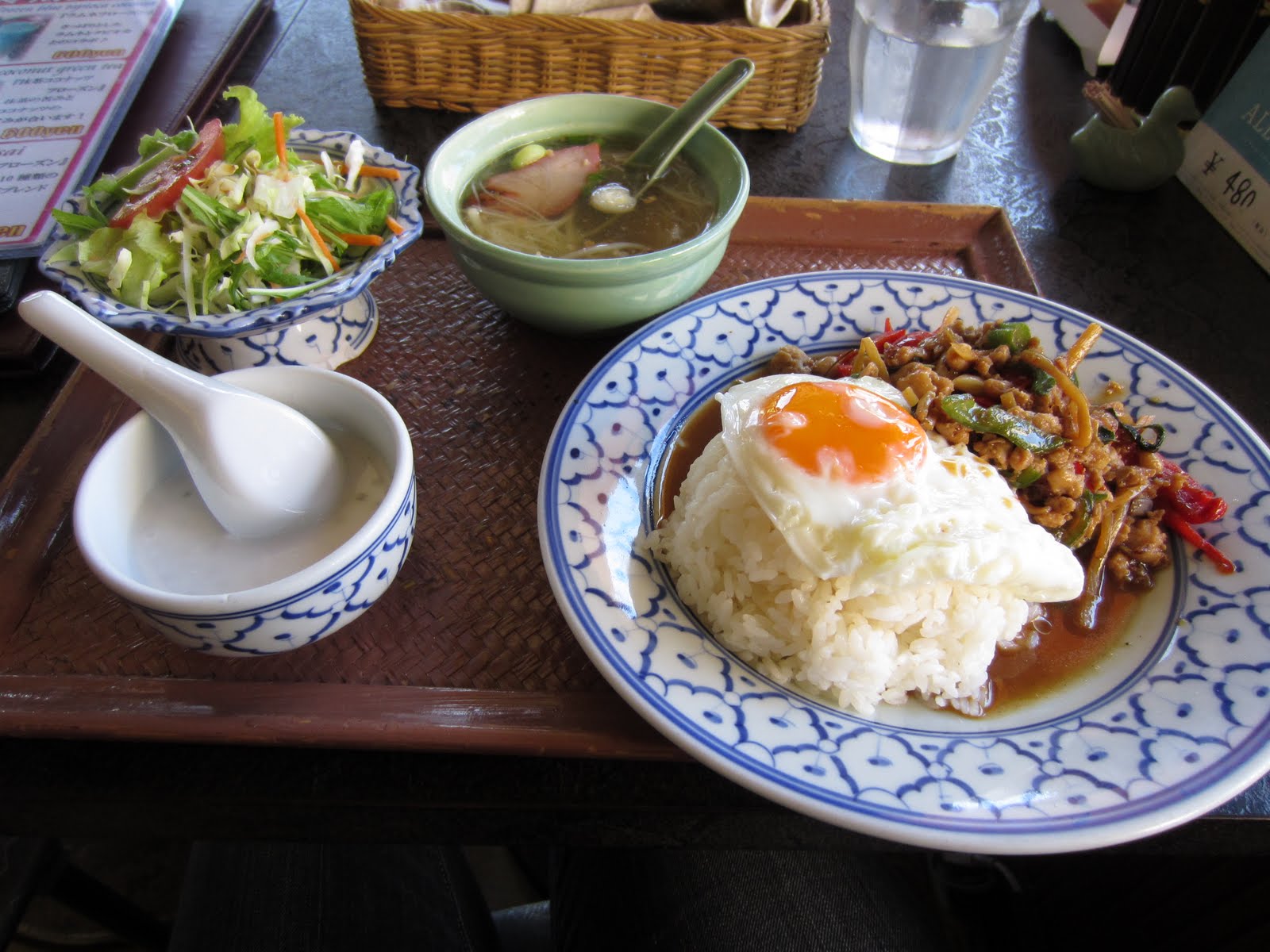
From Sawasdee, outside Daiei mall in Yokosuka
This Thai set meal was only about ¥800 and included the main (gapao), salad, noodle soup, dessert and a drink. I'd certainly recommend this restaurant if you're in the area.

From a restaurant near Fujisawa station
This is part of a Chinese meal I shared with a friend. You can get these sorts of dishes anywhere; there are masses of Chinese restaurants in Kanagawa. Each dish was about ¥800-1000. That pork and 'piman' (small peppers) dish is one of my favourite dishes to order.

From a soba restaurant in Atre, Ebisu
Finally, some more Japanese food. This is 'zarusoba', served cold and topped with nori (seaweed). Soba is a good accompaniment for tempura, since it tastes so wholesome, while tempura is more greasy. This particular tempura dish includes a prawn, okra, eggplant and fish. You take the soba and dip it in sauce before eating it. This is a very standard sort of dish; I got it for perhaps ¥1000. Note that cold soba is a very typical summer dish, so that in winter, there may be fewer of them on the menu.

From a department store around Yokohama station
Speaking of soba, here's soba in a different form - hot, in broth. This was a 'mini oyakodon set' which cost about ¥900. Oyakodon is a donburi (rice bowl dish) with an egg/chicken mix on rice. The 'oyako' in 'oyakodon' literally means 'parent child'. I know, it's a disgusting name!
Oyakodon's flavour is really nice and the juice flavours the rice underneath, but oyakodon often has the problem of using really fatty chicken pieces. This particular oyakodon was quite hard to eat. -_- Also, despite the title 'mini oyakodon' - where both the oyakodon and soba are in serving sizes smaller than normal - this was a huge meal!
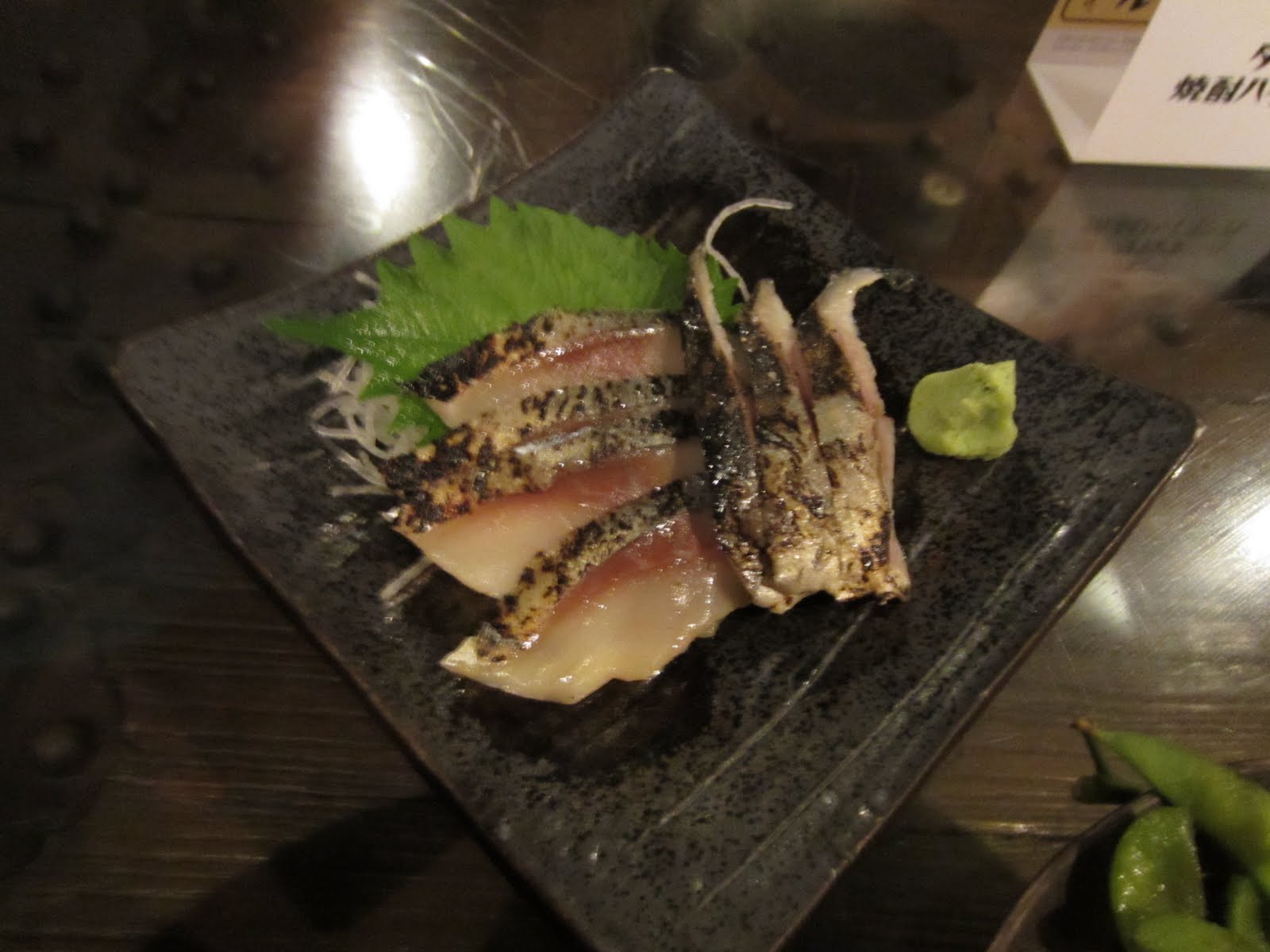


These last three are examples of izakaya food. Izakayas, you may recall, are Japanese-style restaurants where you order lots of little dishes to share, and booze flows freely. A typical dish is ¥400-600 yen. I couldn't post all the dishes we had, but the first one is mackerel sashimi, the second edamame (soy beans) and the third is deep-fried tofu.
Tuesday, 9 August 2011
Batsu game
In Western countries, when you mark answers as 'correct', you use a tick. Wrong answers are marked with a cross.
In Japan, correct answers are marked with a circle ('maru') or a cross ('batsu'). I've even seen Japanese teachers of English check students' writing by circling correct words and sentences in red pen. In Australia, if you circled a word in red pen, it would mean the answer was incorrect, so I guess there's a small cultural difference there.
Anyway, 'batsu' means 'cross mark', but it can also mean 'punishment', and that's where the 'batsu game' comes from.
A 'batsu game' is like a 'fun' way of punishing someone. For example, if you're playing a game in class and one student gets out or loses, the other students might make them do a 'batsu game', like singing in front of everyone, or making a weird face, eating something strange, or showing off some unique skill. It's a popular exercise on game shows. I've seen teachers do it too, punishing other teachers who were late for staff meetings. ^_^
In Japan, correct answers are marked with a circle ('maru') or a cross ('batsu'). I've even seen Japanese teachers of English check students' writing by circling correct words and sentences in red pen. In Australia, if you circled a word in red pen, it would mean the answer was incorrect, so I guess there's a small cultural difference there.
Anyway, 'batsu' means 'cross mark', but it can also mean 'punishment', and that's where the 'batsu game' comes from.
A 'batsu game' is like a 'fun' way of punishing someone. For example, if you're playing a game in class and one student gets out or loses, the other students might make them do a 'batsu game', like singing in front of everyone, or making a weird face, eating something strange, or showing off some unique skill. It's a popular exercise on game shows. I've seen teachers do it too, punishing other teachers who were late for staff meetings. ^_^
Subscribe to:
Posts (Atom)